Chapter 1

Prologue
The waters were higher again, and the clouds—pregnant with the next wave of downpours—were dark and low, bulging over the grassy plain. From where he stood, the man could see the bitter water, a silvery band of light between the grasses and the sky. It had come once and washed away the home, but it had retreated. Since then, it had begun to come back, but not all at once. It came slowly. It grew closer with every turn of the moon, as it had been for many of the great turns of the sun… the end he could see coming but could not stop. He turned away.
Seeing his brothers ahead of him on the trail, already heading home to Mother, he envied their certainty that nothing was changing. He hoisted the deer over his shoulder, picked up his spear, and started after them. There was a lot of ground to cover, and soon the sun would be gone. Alone with the kill, he would be prey for the cats, and he stepped up his pace.
Ahead was Mother, rising almost vertically from the grasslands, piercing the sky like a tall grey fin, her body framed in the reddish-orange circle of the sun setting behind her. The family was there, but Mother was not the solution, just a temporary refuge. When the others came—those strange thin men with red clay on their faces—Mother kept them safe, but she could not feed them.
The fish were plentiful, but the bitter water was on the land, and the deer were fewer. He believed that was why the others came, and why they were coming more frequently. The cats felt it too. They were bolder—they had taken a brother recently—and he believed the scarcity of the deer was the reason. No, Mother was not the solution, but the light from the fire in her mouth was inviting. It was home for now; it was safety, and it kept him going. He needed to keep going. The family was there, and they needed him.
Reckoning
“Please hold your breath,” said the machine voice, seemingly from inside his head.
“You may breathe again,” it said 10-15 seconds later.
“Thank you”, thought Leo. “That’s quite kind of you.”
Leo lay inside the MRI tube, practicing his breathing and trying to meditate to ward off any discomfort. He wasn’t claustrophobic, but he didn’t love the idea of getting stuck or trapped in small spaces such as the one into which he had been inserted. The fact that there were two other people in the control room—one who spoke into his headphones occasionally—was reassuring.
He opened his eyes to the smooth, slightly curved, grey top of the tube just inches from his face and closed them again. The intense banging and clanging of the MRI machine was blocked somewhat by the earplugs and headphones over his ears. After a few minutes, it became white noise, and with his eyes closed, the overall effect was mild sensory deprivation that relaxed him. He thought maybe his sense of touch or smell would step up, but it smelled like complete neutrality in the sterile mobile MRI trailer. Other than the catheter in the vein on the opposite side of his elbow, there was nothing to feel, but the MRI bed was surprisingly comfortable. He thought maybe he could nap…
“Please hold your breath.”
“You may breathe again.”
Leo’s mind wandered, contemplating the choices he had made in his life. Questioning them briefly… but just briefly. He had no real regrets, but in that moment he wondered if his old lifestyle was worth all of the regular examinations, tests, and procedures he’d been dealing with for the last year or so. The doctors were just trying to find out how much damage he had done over the 40 years in which he lived free, without worrying about the consequences of doing whatever the hell he wanted, whenever, however. The guardrails were simple: get to work when you need to, do your job well, don’t fuck up your marriage or your kids, pay the bills. Overall, enjoy yourself, don’t be a dick, and hopefully do some good in the world.
He hadn’t thought enough about the future and certainly hadn’t prepared well for his post-middle-age reality. When he was young, he was pretty sure he wouldn’t even make it this far. Leo suffered from the malady of romanticizing the ‘live fast, die young, leave a good-looking corpse’ approach to life that was somewhat common among his rebellious adolescent peers—mostly the boys, truth be told—and wasn’t even sure he would make it to 21… or the infamous 27… or 30... ‘never trust anybody over 30’ said the generation before him. When he was a kid, he wished he had been born earlier so he could have lived through the ’60s firsthand, rather than through his friends’ parents and books and music.
As he passed these milestones, slowly shedding his blasé attitude towards his future and realizing he may have been a bit cavalier about his health and longevity, the ‘I’m not worried about smoking… I’ll more likely get hit by a bus or something’ idea seemed more and more stupid, but he was entirely addicted to nicotine, and maybe more so to the psychological component. He smoked when he drove, he smoked when he was on a long work call, he loved to smoke, if he was being honest. And he was.
“Please hold your breath.”
“You may breathe again.”
And he drank. He loved to drink. He loved how even the shittiest day couldn’t stand up to the first two tall lowball glasses of Jameson on the rocks. He had never been lewd, lecherous, sad, mean, angry, or belligerent when drinking, so he trusted himself to go too far when it seemed a fine time to do so. He liked himself when he was drinking, and he knew others liked him, too, because when he was loose, he could be witty and clever.
His secret—one that people who worked with him were surprised to discover—was that he was less confident in person than on the phone. The phone was like armor, and he gave great phone. He could talk to anybody about anything—the breadth of topics he was conversant in was pretty impressive—and he was self-aware enough to know when to steer away—to get to the point of the call when he was out of his depth.
But Leo needed a couple of drinks to loosen up when he was in the flesh with clients and colleagues, and—although maybe not necessarily the life of the party—he was definitely a good hang when he got his buzz on… except on those few occasions where he had simply overdone it and made a spectacle of himself around clients or colleagues.
Still, those fucked up nights were the exceptions, and here—six months after quitting drinking—he missed booze… but was so incredibly thankful that it turned out that he had no alcohol dependency. What he did have was a fatty liver. He found that out in his mid-40s and thought the ‘non-alcohol fatty liver disease’ diagnosis was funny as hell. ‘How absurdly ironic! I’m Irish, and I love whisky… for fuck’s sake, can’t I just have a regular alcoholic fatty liver disease?!’ he had thought. It turns out the medical professionals changed the name for his condition to the ‘rolls right off the tongue’ moniker Metabolic Dysfunction-Associated Steatotic Liver Disease, because way too many people like Leo thought the cute name meant the shit wasn’t serious. It was. That’s why he was in the tube.
“Please hold your breath.”
“You may breathe again.”
Shortly after Leo’s first daughter was born, he decided—with a headful of acid at a music festival—that he now had too much responsibility to risk losing his mind in a field full of hippies. Like the majority of his music industry peers, he switched to cocaine and the occasional thumb-dip of ecstasy. Those options weren’t such a huge time commitment, and he could still keep his shit together. It turned out that for far too many clients and colleagues, coke was not “it”… but rehab and complete sobriety was.
Leo, again very lucky, had never really cared much for cocaine. It was utilitarian. He wanted to stay up late to hang with his bands and his industry friends, in person, into the wee hours of the morning, and he needed something. The bands had the best connections, so he knew he was going to get good blow when he did it, and it was fun—or at least the parties and the people were—but when he left the business, he left the party drugs behind. Actually, shortly after he left the music industry, he left a lot behind.
“OK, I’m going to release the contrast now. It might feel a little cold.”
The voice from the control room reminded him of a no-nonsense but friendly and reassuring grandmother. An Indian grandmother. He didn’t know one of those, specifically, but grandmothers are grandmothers, regardless of their accent. ‘Shit. I’m old enough to be a grandfather’, he thought. ‘What does ‘sounds like a grandmother even mean?’ Leo laughed in his head. He liked his inner voice. Usually. Almost always.
He could feel the contrast entering his vein. A nearly imperceptible trickle, but with the relative absence of the other senses, in his comfy mechanical womb, he could feel it like the physical equivalent of a slow dawning of awareness. There had been a lot of that in the last couple of years. Like the rest of his generation, Leo was coming to grips with the fact that he wasn’t 30 anymore. Not 40 or 50, either. He had lived his 40 self-aware years on the edge and by his own rules, pretty free and independent, relatively speaking, and he chalked that up as a solid win. Now, as he liked to say malaphorically, those cows had come home to roost.
“Please hold your breath.”
“You may breathe again.”
The MRI machine buzzed and whirred all around him, magnets and motors and lenses and whatever it was, as it had been for 30 minutes now; then there was a new sensation—a vibration and what sounded like a cell phone ringing, but it was everywhere, all around him. ‘A phone call from God… with the vibration function on, as well’, he thought with a smile. Then the ringing shifted to digital noise. ‘How many fax machines and old-fashioned telephones were sacrificed to make this MRI?’
“OK, we’ll be done in a minute,” came the disembodied voice. The machine cycled down to a quiet purr, then it was silent.
“I’m pretty comfortable,” he said to the technicians as they were removing the headphones and IV and lowering the table. The Indian woman smiled. She was his age—perhaps a few years older.
“I can just chill here for a bit.”
“How was your appointment?” Sam asked when he got home.
“It was fine. I got to spend half an hour with my dumb thoughts.”
Sam didn’t say anything. It was too early for the results, but she was worried, and she knew Leo was, too. ‘He’ll talk about it when he wants to… it’s Leo… there’s no chance he won’t talk,’ she thought. The MRI was not the only thing on her mind, though.
“Did you hear back from Brooke?”
Leo shook his head.
“You have to deal with this. She’s your editor—your only ally at this point… did you text her, too?”
“Sam, I’m the damned communication police. Of course. Email, phone call, text. I know what it means. Stalking her is not going to make it better.”
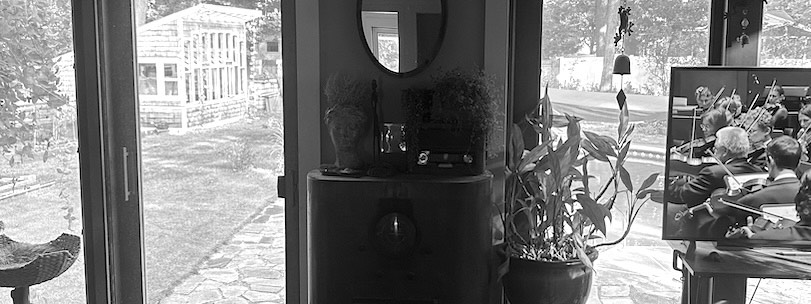
Sam went back to the library—or office, or study… its name changed regularly—and clocked in. Her supervisor could see if she was offline for more than five minutes. It was that kind of job, but it paid the bills. Unlike Leo. Although the study had originally been his office—it was filled with his books and art and knick-knacks—he preferred the sunroom, where he could see the backyard. There was more natural light, and he could play YouTube in the background on the big TV.
‘Hmmm… symphony or house music…’, he thought. It was one or the other lately. Neither had solos or lyrics that would distract him. It was the atmospherics he sought, and the choice depended on what he was writing. These days—although he was writing a lot—he was producing almost nothing. He was stuck. It wasn’t a block, per se, it was more that he had nothing to say… he had fallen out of love with his protagonist halfway through the novel, and he didn’t know how to break it off.
He sat on the couch and watched the bows of the violin section move like the masts of a flotilla of sailing ships in a storm. He had settled on Shostakovich—his favorite—and specifically Symphony No. 5 in D minor. The melody reminded him of a ’70’s TV drama—Kung Fu? No… it was S.W.A.T.. If Shostakovich could rehabilitate himself in Stalin’s eyes with that one, he thought, maybe he could do the same with Brooke. The D minor key was right—not the unbearably sad G minor of his 14th symphony—just the right amount of tragedy before the storm.
Shostakovich was in his ears, but Elias was in Leo’s head. He was heroic, in his own way. Like many fifteen- and sixteen-year-olds, he was presented with disappointment, dealt well with it, discovered a whole side of himself he never knew existed, and saw himself as destined for something great that would be discovered as soon as he got out into the world. So, he set out confidently on a path of his own making, and had a life of adventure. He took part in a broad sweep of history and even played a small part in shaping the future of two towns and his state. In fact, he played an even more interesting role in shaping the Republic of Vermont before that.
This was the easy part. Leo was a cultural historian and a Vermonter. He had also been transplanted from Connecticut, and he identified with the sixteen-year-old Elias’ idealism and passion. He was easy to write, to the extent that some of the things he speculated that Elias might have done turned out to be true in the historical record. The research continued to provide garnets in the schist, and as occasionally eerie as that was, it was always compelling. Then it wasn’t.
Elias was consequential. He was a man of action who served with honor and courage, then his story took an entirely unexpected, entirely unsatisfactory, yet entirely normal turn— ’normal’ in the sense that bad things happen, or people just break, or that thing about ‘the road to Hell being paved with good intentions’—that changed everything for himself, and for Leo by extension. It wasn’t really that surprising, considering what the real historical man had experienced in his life, but it was problematic—to say the least—for the novelist. ‘Fucking research’, he had said at the time. It was a twist that needed straightening, or at least a good explanation, and there just wasn’t one that worked for the story. There was no way to reconcile the historical man with the man on the page.
Something towards the end of the ‘Moderato’—the first movement of the symphony—caught Leo’s ear. He had heard it fifty times, probably, but there was a lilting hope in the sound of the flute as the piccolo—braced by trumpets—picked up the melody. It was sad as hell, he thought, but there was a ray of light. His iPhone vibrated. It was Brooke. ‘Not a ray of light’, Leo laughed to himself as the quadrupled double basses and the cellos opened the ‘Allegretto’ with a villainous flourish. Sometimes life has a soundtrack.
“Brooke, I have tried,” he said in place of a simple ‘hello’.
They were on that level now. She was a mind-reader and a vampire, he liked to think. Not in the mindless monster way, of course—she was brilliant and her ideas so seductive that Leo had a hard time resisting her suggestions. He had never thought of an editor in the way that editors think of editors. The closest thing he could think of in his own experience was his work as an artist manager—before COVID, before he wrote his book—back when he thought artists wanted to hear the creative input of their managers. He hoped he had been as thoughtful and brilliant as he gave Brooke credit for, although he knew for certain he had never gotten that kind of credit. In any case, he was confident enough and wise enough at this point in his life to give Brooke her due, and to shut up and listen… nothing else was working.
“Are you drinking?”
“Now?” Leo chuckled. “No, mother… I don’t really do that anymore, remember?”
Brooke was thirty-three, and way too independent to be anybody’s mother, but this had become part of their banter over the last few years. Leo was her first success, then he was her first disappointment. She even called him a ‘One Book Wonder’ in the middle of a drunken verbal brawl in her Williamsburg apartment. The fight had actually brought them closer.
“I haven’t been avoiding you… I’ve been avoiding the bean counters and haven’t had anything new to tell you. I still don’t… but dude, what can you salvage? You have spent nearly two years on this… and there’s nothing. My boss thinks we must be sleeping together for this to still be going on.”
“That would be giving me far too much credit, babe. How old is your boss?”
“Forty-ish?”
“That explains it… that explains a lot. Tell him to go fuck himself.”
“Will do. Good idea… seriously, though, what the actual fuck, Leo?”
“You can ask Sam—I come to work every morning, and I write. There’s an indentation in the cushion that exactly fits my ass—”
“What the hell are you listening to?”
“Ummm…” Leo clicked the remote to see. “That was the end of the ‘Allegretto’—it was a little abrupt—was it too loud? I can turn it off—”
Brooke laughed. “No, I mean ‘what the hell are you listening to’? Nevermind… I never really got into classical music. You do you, but now do me—do me a favor. Is there a character there you can work on, something to put all of this research and time to good use? You are running out of time, man… I am really not kidding at this point. I can only keep the wolves at bay for so long.”
The sad strains of the ‘Largo’ accompanied the end of the call.
Paradise
April 18, 1749 ~ Emfraz, Ethiopian Empire
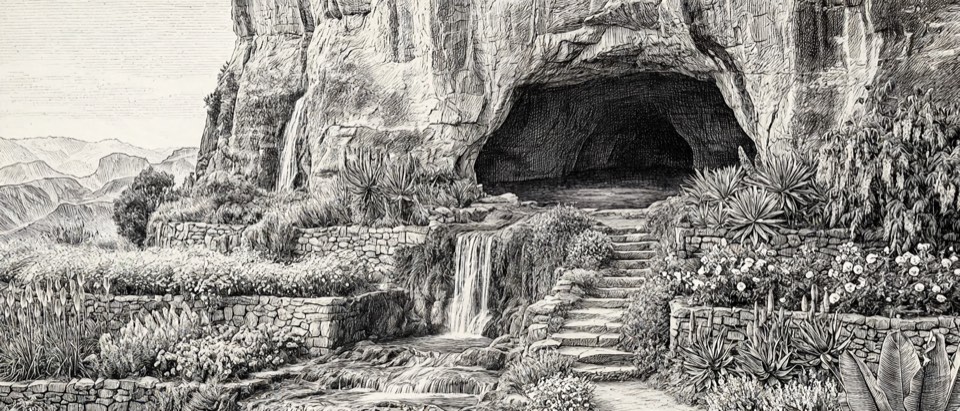
A newborn filled his lungs for the first time and announced his arrival with a wail. Laughter and cries of joy erupted from the women surrounding the mother, now supine, head resting on a pillow. Her chest was heaving, and her legs—damp from the clear spring water of the grotto’s shallow pool—still quivered from the effort. Tears of happiness and relief coursed down her cheeks.
“Chava, my love, look what we have made!” said the man kneeling by her side as one of the women placed the newborn on her chest. He tenderly caressed her face, wiping the tears as the boy latched on without hesitation, making little cooing and gasping noises. As the midwives slipped out of the cave to give the young parents their privacy, the sun was setting in a magnificent wash of purple and orange over the sparkling surface of Lake Tana.
The Elysian beauty of Jonathan’s birth—as relayed by his parents and the midwives over the years—was an apt prelude to his charmed childhood. He had passed from the womb to the cooler waters of the grotto pool, then into soft cotton and the loving arms of his parents. His world was a pastoral wonderland of tidy stone buildings with thatched roofs, fruit trees and a large, terraced garden—bursting with color—embracing the gently sloped waterfall lazily spilling from the spring-fed cave pool.
How a boy of Portuguese and Tunisian parents came to be in this magical place is a story that Jonathan slowly pieced together himself over the next eighteen years, as his parents were not prone to discussing their past. What he knew for certain, as he lived it daily, was that theirs was a love story. Chava was from the island of Djerba—a subtle blend of Italian, Greek, Spanish, and Arab-Berber lineage—and a Mediterranean beauty by all objective standards. When Joaquim da Costa first set eyes on her, he never looked away again.
Joaquim would always say that meeting Chava in the market in Djerba was the happiest, most serendipitous event in his life, which had been otherwise planned and executed with intention. The ship carrying him from Lisbon to Alexandria had stopped in Djerba, and while exploring the port market, he came upon her admiring a bolt of the island’s famous purple cotton. Seeing her walking away empty-handed, the smitten man bought it and followed her into the street. She refused his gift, as one should, but he was so persistent and charming as he walked beside her—bedazzled by her sun-bathed beauty, entreating her to receive his offering—that she finally gave in. Joaquim abandoned his passage to Egypt and rented a room in town. Within weeks, she had accepted his marriage proposal.
Chava’s parents were, of course, deeply concerned. They knew he adored their daughter, was financially stable, a scholar, and a fellow Jew on his way to study the Ethiopian Beta Israel community—and they were not immune to his considerable charm—but their daughter’s impetuous decision to run away with a man she just met left them bewildered. They also knew—seeing the glow of irrepressible love and excitement on their daughter’s face—that it was more than possible that she would elope without their approval. They had to trust her willful, irrepressible heart, and barely a month after that chance encounter in the market, Chava and Joaquim were on their way. The whirlwind romance was only strengthened on their long, hazardous voyage to Emfraz, where they immediately began preparing for the child that was on its way.
The farm was technically owned by The Levant Company—who had surreptitiously maintained an Ethiopian presence as a placeholder for any future official trade relationship—and the caretaker was a Portuguese man named Mario Pontes. A theologian trained as a Jesuit—although he publicly denied as much due to the ban on the brotherhood in Ethiopia—whose academic focus was on the Orthodox Tewahedo Church, his knowledge of the Amharic language and its classical ancestor, Ge’ez, led to the London-based company’s offer of employment. He gladly accepted, correctly assuming there would be little to do, and having a curiosity about the legend of Prester John. The mythical Christian king of Ethiopia, whom the Crusaders believed would bring a huge army to the Holy Land to help liberate Jerusalem from Islam, may have never made his appearance, but he had fascinated generations of scholars like Mario.
With time to pursue their intellectual interests and other passions, Mario and Joaquim spent evening hours together in the grotto, discussing, debating, and arguing as Jonathan watched and listened. Mario’s days were dedicated to ceramics—his true passion—and over the years he had built a studio and created demand for his traditional Portuguese tiles and crockery. Joaquim’s passion was for teaching, and with Mario assisting and translating, he began holding evening classes in the cave at The Grotto, as it was known locally, soon after he arrived.
Joaquim’s humble, scholarly demeanor and non-judgmental embrace of all of the Abrahamic faiths overcame the local community’s initial skepticism, and they came to trust that his secular classes—reading, writing, grammar, mathematics, and geography—were not a challenge to their own faiths. What began as informal classes grew into a structured educational opportunity on par with what wealthy children might get from tutoring. Before long, some parents and other young adults were attending, and within a few years of his arrival in Emfraz—as he became a fluent Amharic speaker—he became a trusted, impartial scholarly advisor to many in the community.
Chava was a loving partner to Joaquim and an attentive, caring mother to Jonathan—their only child—but she also became an invaluable member of The Grotto’s small enterprise. The descendant of a long line of potters from her town of Guellala—well-known for its fine traditional products—she partnered with Mario and expanded the studio business with her Djerban designs. Furthermore, and equally serendipitous, Chava had been apprenticing with an herbal healer when she met Joaquim, and The Grotto was filled with rare and exotic species that had thrived there for generations—a veritable treasure trove of herbs, shrubs, fruit trees and flowers—spilling from the splendid cascade of terraces that flowed with and around the gentle waterfall at the heart of the property. She was able to revitalize the neglected garden and the small trade in healing herbs that Mario’s late wife had maintained.
Between the pottery studio, the herbal healing practice, and the school, The Grotto was a busy place. Joaquim’s fairly substantial annual salary— ‘salt money’, as he liked to call it—and inconsistent and intermittent work duties allowed him to invest his time in the school. Although he did not charge for the classes—his consulting practice, the pottery studio, and the herbal products businesses benefited. By the time their son reached his fourth year, Joaquim and Chava had gone from curiosities to local celebrities. As he grew, Jonathan also stood out from his peers. It wasn’t just the lighter skin, the wavy, jet-black hair, and the green eyes—there were plenty of Mediterranean and even a handful of other European people in the community—it was his overall bearing and presence. He had a confidence and a quiet magnetism that attracted others to him, without any real effort or intention on his part. He wasn’t in the least bit shy, and could be gregarious and quite charming, but he was content to be part of the group without being the leader.
The Grotto provided a rich social life, and he and his band of friends explored the mountains and foothills, sailed and fished Lake Tana in papyrus boats, and cooled off in the streams and waterfalls in their spare time. Spare time, however, was limited. Leisure was cherished but not common in this society built largely around subsistence farming and artisanal work. Like most of his peers, much of Jonathan’s time was spent tending crops, herding sheep and goats, making pottery, and helping to care for the garden.
Schooling, however—more than chores and play—was the primary focus of Jonathan’s childhood, and to the same extent, his son’s education was the primary focus of Joaquim’s efforts. The intensive academic immersion administered by him and Mario was built around Greek, Latin, Aramaic, and the seven liberal arts of classical antiquity: the trivium of grammar, logic, and rhetoric fascinated Jonathan—it was the foundation—and built upon its scaffolding was the quadrivium, which was approached from a young age through the study of music.
The dense pedagogy presented music in the context of the classical quadrivium, in which arithmetic dealt with numbers as abstract concepts, geometry addressed numbers in space, and music was the study of numbers in time. Together, the study of geometry and music was intended to enhance the study of astronomy, which was essentially numbers in space and time. He understood this theoretically, but it bored him to tears.
Jonathan was moved by what he called the ‘spirit’ of music, which for him was grounded in a more emotional, visceral reality, and he found that outlet in his neighbor from down the mountain—a travelling musician, or azmari—who introduced him to stringed instruments, of which his favorite was the one-string bowed lute called a masengo. He also played the bamboo flute known in the highlands as a washint, various percussion instruments, and, thanks to his local community, was able to indulge in music performance—freeing the art from the mathematics and science, as he saw it—and the communication and connectedness it provides to the players and the listeners.
Joaquim was a good teacher, and Jonathan loved learning. He dedicated himself to his studies, eventually assisting his father with younger students. He absorbed classic literature, history, and philosophy, wrote poetry, painted, and played music, but it was in languages that he actually excelled. He had a gift for it, as his mother often said with wonder. Amharic was his true native tongue—the language of his community—but from the time he could speak, he was equally fluent in the Portuguese, Tunisian Arabic, and Hebrew spoken at home. Seeing that his son had a knack for language, as he himself did, Joaquim taught him Spanish and French, and—with a local Greek merchant who had spent years in London—they studied English together, as it was becoming an important language in science and literature.
Jonathan became aware of the unusual focus on learning at an early age, and asked his father why he had to spend so much time on his studies. The answer was simply ‘you have a special calling, son, and your education is the key’. He didn’t understand at the time, but with remarkable patience, he did not dwell on it. He trusted his father implicitly and committed himself to his studies. For his part, Joaquim was eternally grateful and constantly amazed by the boy’s curiosity and aptitude for scholarship and thought.
Although awareness of his idyllic life came slowly, it did finally arrive with adolescence, when some of his friends became old enough to work full time and stopped coming to The Grotto. He noticed how different their lives were. Some had more, some had less, but recognizing his relatively good fortune made him more attuned to the other disparities around him.
Despite his increasingly visceral reactions to the injustices of the world—particularly Emfraz’s thriving slave trade, which had always been a background fact of life—Jonathan’s interest in political philosophy was Aristotelian, theoretical, and academic. Joaquim and Chava had done their best to keep him from the realities of the world by giving him a brilliantly curated life. Although they knew this would eventually change, they were content to keep him safe and happy, and they were very proud of the sensitive, idealistic young man they were raising.
The Secret
March 15, 1767 ~ Emfraz, Ethiopian Empire
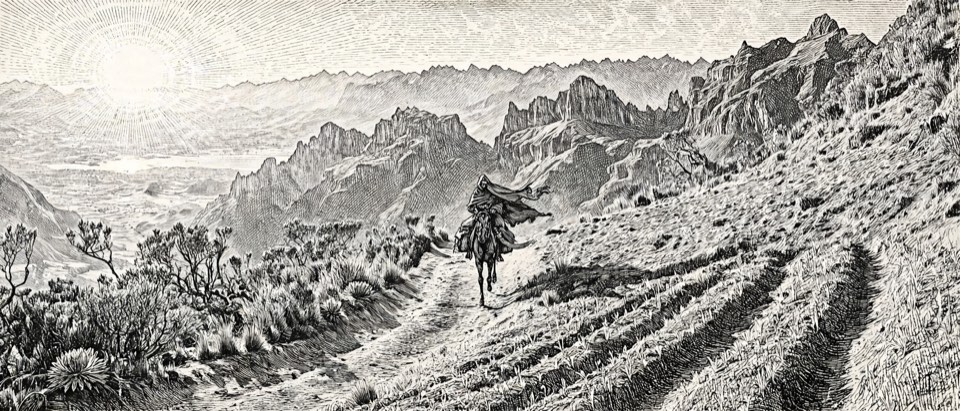
On the ides of March in 1767, Jonathan watched a lone rider wend his way up the mountain to the farm. It was belg, Ethiopia’s short rainy season, and he was planting teff and wheat in the long east-west rows parallel to the road. He stopped the donkey team and stood leaning slightly on his ard plough, watching the man approach. The dusty cloak and scimitar scabbard hanging from his bulging saddlebags indicated he was not a local. He rode straight to him and put on a tight-lipped, strained smile.
“Good afternoon, Jonathan,” he said in Arabic, with an unknown foreign accent.
“Welcome, sir,” he replied warily. “May I ask how you know my name?”
“Your father has told me much about you, not just your name.” The two looked at each other without speaking. “Can you please lead me to him, and a drink of water?” the man finally asked. This was Jonathan’s introduction to Selim al-Fakhouri, and the beginning of the rest of his life.
The main ‘room’ of the grotto was about forty feet wide, just as deep, and fifteen feet high. The shape had always reminded Jonathan of a quarter of a lemon, laid on its side. Its near-perfect arc was cut into the mountain that continued to rise above the broad plateau. From the fields, it was mostly hidden by a copse of trees—upside-down-heart-shaped pencil cedars, flanked on both sides by squat kossos, with their thick, peeling branches. The blooms had come off the trees a little more than a month ago, and now he wondered if he would ever see those long clusters of pink and muted orange flowers again. He stared into the throat of the cave, watching the shadows of his father and Selim dance in the firelight. They were speaking, but Jonathan had tuned out their words, sending them to the background behind the fire’s crackle and the chorus of crickets so he could think.
“It was all a lie… a charade… but I didn’t know I was playing.” The thought had been swirling in his mind, but he was surprised to hear his own voice. Joaquim and Selim stopped speaking and looked at him. “Do I just keep playing, now that I know it’s all a lie? I don’t even know what is true now. I had never even conceived of the thought that my whole life was… it isn’t even a charade. It’s a puppet show…” he said quietly, trailing off.
Selim cleared his throat. He was not a large man. In fact, he was slender, like Jonathan, and about the same height. Jonathan, however, seemed light and ready to spring in any direction, whereas the Arab was the embodiment of gravity—a solemn, heavy, weighted presence that could possibly be immovable. He had a scar that ran through his left eyebrow, across the bridge of his nose—a ‘Roman nose’ was the expression that came to mind—and continued across the ridge of his right cheekbone. Jonathan assumed it was from a slashing blade that had just missed its mark, cutting the pronounced surfaces, as he sized up his escort-to-be.
‘He has brought disruption, and now will ensure my safe passage to a new life I didn’t choose and don’t want’, he thought, studying Selim’s imposing figure in the firelight. ‘He looks as if he’s been carved from the floor of the cave’. It wasn’t just the sun-bleached black cloak with its grey streaks of dust that resembled the rock wall’s striations, nor was it simply the stillness with which he sat. It may have been the sharp angles of his chiseled face, grey in the muted light, like his fading black hair and salt-and-pepper beard.
Selim’s eyes were also black, but there was a bright spark in them that cut through the rest of his shadowy countenance. Jonathan sensed an intelligence in those eyes and wondered if—in this man—that translated to wisdom and a sharp intellect, or cunning and guile. He didn’t know, and couldn’t really venture a guess, because Selim was utterly inscrutable.
A donkey brayed below them, and a dog barked in the distance; then it was silent again, other than the crickets and the dying fire.
“I am not a puppet,” Jonathan said as he stood and walked out of the grotto’s firelight and into the night.
“Did you know?!” he yelled as soon as he walked through the door.
Chava looked up from her chair by the fire, startled—her son had not raised his voice to her in years.
“Did I know what?” she asked, confused.
He could see she was not lying. She may not even be capable of lying, he considered. “Father is not who he says he is, and neither am I.” At this point, Jonathan—not generally prone to emotional outbursts—lost control and the tears began to flow. He sat on the floor at Chava’s side and wept in her lap as she silently stroked his hair. Although her mind was filling with questions, she pushed back her concern and let him cry. After a few minutes he looked up, clear-eyed, but puffy, and asked her to go back to the fire in the cave, to hear for herself the ‘special purpose’ for which Joaquim had been raising his son—her son—to fulfill.
Selim stood at the edge of the light, and Joaquim stoked the flames as Jonathan and Chava entered.
“I think it is unwise for you to be here,” Selim said quietly, his demeanor respectful to Chava as she took a seat by the fire, across from her husband.
“She stays—she will understand,” Joaquim replied quickly and definitively. He did not know where to start. ‘How do I explain to the love of my life that I have been deceiving her since the day we met?’ he thought, in a panic, despite having pondered this matter for over eighteen years.
“I can trace my ancestry to the 8th century,” Joaquim blurted out as Selim sat beside him and Jonathan took his place next to his mother.
He was immediately interrupted by Mario, who had quietly approached from the darkness beyond the arc of firelight. “Is this estimate based on the Gregorian or Hebrew calendar?”
Selim chuckled, which came as a complete surprise to Jonathan, who hadn’t considered mirth to be an option for the man.
“I mean, it’s a reasonable question,” continued Mario. “Just because we three, you, Selim and I—a Jew, a Muslim, and a Christian—can share a secret, it doesn’t mean we can share a calendar or a bowl of scallops and pork.” He took a seat in the circle around the fire, between Jonathan and Selim, whom he poked in the ribs as he sat.
“Don’t get too familiar with me, old man,” the Arab said with a slight smile.
‘Leave it to Mario to cut through the tension’, thought Jonathan, and as soon as he had the thought, he became sad again. ‘Will I be saying goodbye to Mario for good when I leave?’ he wondered.
“I am still in the dark, my love,” said Chava to Joaquim, then turning to face Mario, “and it appears you know what this is all about,” she said with an accusatory edge. She turned back to Joaquim. “Can we please continue, so I can know what has caused our son such consternation?”
“Mario, my pedantic friend, we are using the Gregorian calendar, yes, but we ought to be using the Ethiopian calendar, considering our present location… and since none of the three of us are actually Jews, Muslims, or Christians, none of us should be offended,” said Joaquim, with a slight upturn of his mouth. It was intended as levity, but he had forgotten for a moment that Chava still had no idea what was being discussed. She looked at him with such confusion that he instinctively reached for her hand and clasped it tightly.
“I don’t even know how to begin, so I’ll just say plainly that everything you know of me—except my character and my unquestionable, pure love for you—is not quite as I have represented it to be, and I am so truly, deeply sorry.”
Chava’s expression was devoid of emotion as she looked across the circle at her husband. “I do not understand what you are saying,” she finally said, the tinge of fear in her voice catching up to her racing thoughts.
“Chava, I am part of a group—an order, if you will—that is built around a powerful secret.” Joaquim paused. “I know that it sounds as if I have lost my mind, but it will make sense as I explain a bit of the history.”
“I don’t care if it makes sense—what does it mean—why are you telling me this?”
“It means Jonathan must make a decision, and it is not really a choice… he just”—Joaquim sighed deeply— “he has to go.”
Chava’s expression went quickly from blankness to confusion to fear and disbelief as Joaquim continued.
“He must travel to Portugal. My parents and I are from Porto, but my ancestors lived in Sintra long before the scribe started the family genealogy. Of course, before him, there were others, but there are no written records, because... however, the… um… the order—it is called ‘A Luz’, which is…”
He had always pictured himself delivering a version of this speech as a clean oration or a crisp lecture but was thrown off balance by the interruptions and his own fear.
“What scribe—Portugal? Records? What the hell are you talking about?” Chava was now shifting to anger.
“We need wine,” said Mario, before Joaquim could respond. “Lots of wine. Lots, and lots of wine.” He stood quickly and walked off towards his house.
“Sure,” Chava called to Mario as he hurried away, her voice bitter. “You don’t need to hear this—you already know!” She turned back to Joaquim, grabbing Jonathan’s hand in hers. “What is it that everybody here knows except for me?”
Jonathan squeezed her hand three times, and she squeezed back. As long as he could remember, this was their silent way of telling each other they loved them.
Joaquim tried to continue. “The order—it is called ‘A Luz’, which is—”
“The light, yes—” interrupted Chava, switching to Portuguese, “—don’t be pedantic yourself, my dear.” There was a cold sarcasm in her voice that neither Jonathan nor Joaquim could ever recall hearing, and to the same extent that it confused Jonathan, it was exactly what Joaquim had been fearing.
“Yes, The Light,” Joaquim continued. “You could say that we shine a light on truth… we remember the past, and understand what really happened. A Luz is an ancient order. We protect a secret so powerful that—were it to get into the wrong hands—it could spell disaster for all of humanity. We have been doing so for more than twelve hundred years, and we use the power—the secret that we protect—to in turn protect the secret.”
Chava chuckled. “You have a secret power that you use to protect the secret of your secret power?”
Mario and Selim both suppressed smiles as Joaquim considered his response.
“When you put it that way, it sounds somewhat pointless and circular, but yes,” he finally said, struggling. “But I have… I have seen the power and I know it to be true like I know what I see and hear and taste… and I know it is in the hands of those who are good, so I have dedicated my life to protecting it… because I also know how real the danger is.”
Shaking her head, Chava looked around the fire. “I still do not understand. So, you have a secret. I have never seen you—or Mario, for that matter—do anything with this secret. What does it do, and why does this matter to Jonathan—why does he need to go to Portugal? To learn your secret? Then what—what does he do with it?”
“The secret is passed down through generations—there are exceptions, but this is how it is handled. Luzite children are prepared to accept this responsibility, and if they are deemed worthy of possessing this knowledge, they are trained and initiated into the order. The children who pass through their childhood and are not found to be good candidates never know any of this. They simply get a good education, and they live their lives.”
“I assume, because you have revealed this, that our son has been deemed good enough to join your little brotherhood?” Chava was still dishing out the sarcasm as her anger subsided to a simmer from the boil it had reached briefly.
“It is not a ‘brotherhood’—there are an equal number of women—but to answer your question, yes, he has… most people live unexamined lives, but Jonathan is already an open-minded, free-thinking young man with goodness in his heart, and the integrity and courage to handle such a responsibility.”
“You still have said nothing of what this responsibility is…” she trailed off with a chuckle.
“I have told you, it is to protect the secret and the group, and to learn our ways. Look at how much evil is in the world. Would it not make you happy to know that most people lean towards the good, because they see it in nature? It is true… but the more they are removed from nature—the more they stand still, distracted by the works of humanity, separated from the truth of the natural world—the more susceptible they are to the lies and twisted truths that evil uses to trick people into following it. We use our knowledge of history to keep track of evil, and we use our power—which we call The Weight—to confront evil.”
Mario returned with a jug of wine and mugs, and handed them around the circle, pausing when he got to Jonathan. “I’m not a boy, old man,” he said, reaching for a mug.
“If you weren’t already a man, then surely you are now. Discovering that your father has filled your head with crap your whole life is often a first step in that direction,” quipped Mario, filling Jonathan’s mug. Joaquim rolled his eyes at the weak attempt at humor, but nobody else reacted.
Chava raised her mug: “To truth, and to our Mr. da Costa… if that is still his name,” she said with the same biting tone.
“Chava, please,” Joaquim pleaded weakly.
Nobody raised their mug. Selim stood and put another log on the fire, sending sparks upward towards the stone ceiling.
“Wait,” Chava said, a thought taking shape. “I was not worthy? I am not open-minded and good?!”
“I did not say that, my love—you are absolutely worthy, but by the time I met you, I was already on this path to my destination, and, well… I could not tell you.”
“Ahhhh, right,” Chava replied, eyes blazing. “You needed to lie to me for eighteen years, until our son—your secret protégé—was old enough for you to tell him, then send him away.”
Joaquim looked truly pained. He had nothing to say to this, and it was what he feared the most from this conversation. He had harbored this fear from the day he met her.
“I could not tell you, Chava.”
Jonathan was working to process all of this as he listened to his parents sparring. He had already heard most of Joaquim’s explanation less than an hour earlier—but even on the second telling, it was simply too much to get his head around. Struggling with the deeper implications of Joaquim’s facile explanation of this calling or duty he had, and still not ready to confront him about the lies, he reverted to his defense mechanism: he intellectualized the slow-moving emotional crisis to buy himself time.
“From what I gather,” he said, “and to break it down to simple terms, there is a truth, A Luz protects it, and they have a power called The Weight that helps them to protect it, and the power is so great that it is dangerous for the rest of humanity to know… so only A Luz can do the work. This sounds very Hobbesian to me.”
Joaquim suppressed a smile, but Mario laughed out loud and clapped his hands a few times. Jonathan was startled and didn’t know if it was in mockery or appreciation.
“That is a great synopsis, and it shows you grasp these ideas well—a tribute to your father’s tutelage, no doubt—but here is where it gets interesting, and I apologize if I mix metaphors, but A Luz watches the watchmen. It’s that simple, and that’s why we are careful.”
“Listen to you all, quoting philosophers and making your academic points…” said Chava quietly. “So, Joaquim, you’re not even a Jew…”
He cleared his throat and took a large sip of wine. “No, my love… but I love our Judaism. It is a wondrously contemplative, thoughtful faith that I have easily adopted as an identity, because I—”
“Because you needed to lie. You needed to lie to my parents because you knew they wouldn’t allow me to be with anything else… and I am the fool for believing you, for believing in my God, and believing that my husband was the man he said he was… is that it?”
“Well, yes and no, but you are not a fool—”
“Oh, you are just a great deceiver, is that it?”
“Please, you cut me off and put words in my mouth. I needed to lie to everybody. I needed an identity that I could comfortably inhabit—that would not draw attention to me—and the fact is I believe in most of what Judaism teaches, and I also feel the same way about Islam and Christianity, and nearly every religion I have studied, as they share universal values that are intrinsically good, but when men get involved—when the faiths become institutions—they become corrupted by power… they become mechanisms for control.”
“Oh, of course—my religion is… insular and narrow… is that it? And your truth—which still has no substance, just a lot of mystery history and secrecy—is a much bigger belief. Am I supposed to just accept the new you and your new old religion… without questioning what it even means, because you are telling me a story that is supposed to explain and justify… hiding yourself from me, like God hiding his true face from mere mortals? This is so utterly insulting!” Her voice had gradually risen to a yell, but still, Chava did not move, despite her desire to run and scream into the night. She knew there must be more—there had to be more—for any of this to make sense.
“Chava, this is not about religion or a belief that looks down on yours—I have to ask you, when do we ever discuss religion and faith? We discuss the world, love, family and friends, the things we care about, but do we ever discuss doctrine or being Jewish when we thank god for our boy, or for a good harvest, or for anything? No, we don’t thank our religion; we just thank god, because we know what that means, and we don’t have to question or discuss it. We have always been modest, private, practical people in this regard. We attend temple for the community, yes? Because we love our friends and neighbors. We consider the great ideas and words of wisdom that our religion has passed down to us, but we don’t praise our religion; we simply praise the wisdom of some who practiced it, and we profess our love of god and the world and the people around us.”
Joaquim paused to catch his breath. This was all true—he realized this was the path to understanding. He needed to ground his revelation in something Chava could recognize as truth.
“On the other hand,” he continued, “we see the supernatural stories as myths—more like ritual than faith, yes? I believe the same things as you, but I have a different language and context for them… my beliefs encompass your beliefs… I could no more dismiss the things that you find meaning in than I could dismiss my leg for not being the whole of my being. I have never looked down on you or condescended to you, and I know when you hear more and understand what I have been taught, then you will feel the same as I do. My system is not entirely foreign to those beliefs we share; it is just... more.”
“This does make some sense to me, mother,” Jonathan interjected. “I have found it difficult to believe in any religion for some time now… I don’t have real faith… in some ways this comes as a relief.”
Chava leaned away from her son so she could see his face more clearly and flashed him a look of surprise, with a touch of anger. “Oh, so now that your father tells you he is not—and has never been—a respected Jewish scholar, you suddenly aren’t a believer, either?”
“What I know, mother, is that something I have been unable to believe has now been confirmed by my father—a man I trust… or did trust, but still trust in this matter, because I was already thinking the same thing—to be a sham. Or at least his belief is a sham, and that makes me feel… safer… and perhaps less mad.”
The circle remained respectfully silent while Jonathan considered his next thought. “I have silently resented feeling like I was flawed for having doubts. Muslims, Christians, Jews… I have been raised to respect these faiths… they share the same ancestors and the same God. Christians have their miracles and their ‘God as man and spirit’ problem, and I was taught that ‘that is just the Christians’ odd thing’, but the Muslims and Jews have their own miracles and odd beliefs.” He paused again. “Honestly, yes, this feels like a relief, and I am sorry, mother—that is not what is bothering me… I know your own beliefs are, well, far from orthodox… so I am fairly certain your anger is not about an affront to your religious pride. I am sorry; I mean no disrespect.”
“No, Jonathan—you are right—you are both right,” Chava began, “what you say about what we believe and how we live is all true, I understand that… but it was not right for you to keep all of this from me, Joaquim, and to allow me to think that you—”
“Yes!” Jonathan interrupted his mother, turning on Joaquim with palpable frustration. “That is what is bothering me! Why did you have to lie? Why couldn’t this just be who you are?”
“For the most practical reasons, Jônatas,” answered Joaquim, using Jonathan’s Portuguese name—his grandfather’s name—instead of his given Anglicized version. “It is heresy. You see that, right? Our beliefs, even having our knowledge—the secret—are heretical to all of the Abrahamic faiths. Your grandfather would not have existed, nor would the many generations of the order who preceded him, if we didn’t have the strictest rules of secrecy. Our defense against persecution is invisibility and camouflage, as it has been since at least Roman times.”
“But why couldn’t you tell your family, at least? I have spent my life training for, for what—to become a member of… a mystical sect… a secret society… a cult??”
Joaquim ignored Jonathan’s rhetorical jab and turned to Chava. “I have loved you with all of my being since the moment I laid eyes on you in a dusty bazaar on a tiny island in this vast universe. If I ever believed there was a god guiding my life, it was right then. I have never kept anything else from you or acted out of anything other than complete and total conviction and integrity when it came to you or anybody else. Never. I am still the same man, driven by the same sense of purpose. My beliefs are based on compassion and love—just like the best teachings of any great religion—but they are not sullied by the politics and the hypocrisy that mar these faiths when they are applied to the worldly affairs of men.”
His passion was rising—it may have been the wine—as he continued his defense, raising his voice a little, “I have not changed! If I had presented myself as a Luzite, would your parents have accepted me? As loving and caring as they are, do they not distrust Christians, Muslims, and even other Jews who don’t share their own unique traditions?”
Jonathan shifted to look at his mother as his father spoke. This was a topic that had been close to his heart since he became aware of the injustice he saw around him. He listened closely, watching her reaction.
“I am not castigating or criticizing them, or any other good people—I am saying they are not ready for this truth… it is too disruptive to the idea that we must separate ourselves from other people because they have different ideas, or customs, or even skin color. That is not godliness, that is worldliness, and that is what keeps us divided so we can be ruled by tyrants—greedy men who just want power, who just want more, who twist the words of truth and wisdom to control and manipulate…”
Joaquim trailed off for a second, calming himself before continuing in a softer tone. “I have kept my identity secret since my initiation, and despite every other pressure or temptation of doubt or fear, I have never been more conflicted than when I met you. It may have seemed easy to you, as it was for me, to fall in love… but when you were not there, those days and nights in Djerba when we were not together, I was in agony.”
He held his cupped palms in front of him. “Here, in one hand,” he said raising the left one, “was the greatest person, idea or thing I have ever seen, met, heard or even thought of—you, my love—and here, in the other hand was a sacred commitment to protect something that explained the world to me, and gave me purpose when I was unsure, and meaning where I saw… emptiness… but when I met you I knew I would never again see emptiness in anything, and I had to figure out how to bring together these two things I needed most—” he brought his hands together in a prayer gesture— “and I knew I could, because they were both my hands, attached to me, and they could never be in conflict with each other, because they weren’t separate from me.”
Jonathan stood and walked to the edge of the cave, looking out over the shimmering, brightly lit surface of Lake Tana in the distance. While they had been in the grotto, watching the light of the fire diminish, the moon had been rising. He stepped out and looked behind him to see it cresting the ridge in its brilliant fullness. The dog barked again, and further in the distance a wolf howled. From inside the cave, he heard Joaquim’s voice crack.
“It was easy, really, because my beliefs don’t discard or cheapen yours; mine say ‘yes, there is this—and… this truth can be built upon. I don’t know how else to explain it, but if I had been in conflict, after resolving to have both you and my secret, then you certainly would have known—you would have seen it and felt the conflict in my spirit.”
Returning to the circle, he could see his mother’s eyes were moist with tears. She glanced at Jonathan, but didn’t look up to face her love, Joaquim, who had closed his eyes to fight back his own tears. Nobody else spoke, either. They sat in silence—not awkward, but rather, a contemplative, respectful silence.
Jonathan loved his home, his friends, his teachers… his community, as a whole. He loved the earth, the plants and the animals that he tended to. He loved the seasons. He loved his family, and he loved the idea that he would live his whole life here—find a wife, have children, carry on the farm and the school. It was a comforting, safe, and predictable vision of his future, and he had frankly never really thought about any other option or notion of himself, somewhere else, doing something else. It had simply never occurred to him. Now there was a radical new thought, a complete disruption, a new vision… and he realized he was excited.
“Father,” he began, turning to face Joaquim as he turned back to the interior of the cave. “I can understand your reasoning, but it will take some time to forgive the offense. I know that sounds like a logical response, but I know my own heart.” He looked at the rest of the circle, one by one, meeting their eyes, and stopped at the last face—that of Selim, opposite him in the entrance to the cave.
“The issue of my father’s deception is just one matter with which I grapple. The other is that I am being asked, or told, to accept that my father is not who I thought he was, and that he is part of a mysterious group who have a secret we cannot talk about… and that I have been raised for a special purpose—which is to join this group to protect this secret that you can’t tell me—but that means leaving here and going on some long, dangerous journey to Portugal, during which ‘much will be explained’. Do I have this correct? I am supposed to just accept the lies, the mystery, the potential for disaster, death… and just have faith, because my father tells me part of his life’s secret story, having lied about the rest up until now… but I just need to have faith.”
Selim’s face was expressionless, revealing nothing. Jonathan turned to Joaquim, who quickly looked down at the cave floor, avoiding his son’s questioning eyes. “Yes,” he finally said, looking up.
“Didn’t I just get done explaining my skepticism,” Jonathan asked quietly, “and that I am already having a hard time even believing that which I have been raised to believe? Now I should believe something entirely fantastical… and then commit my life to it?”
Mario laughed a little at Jonathan’s assessment of the absurdity of the situation, and in so doing, inadvertently invited Chava to address his complicity. “Did your wife know?”
“No,” Mario said quietly. “She wasn’t like you, she was… content with simpler things, and our simple life, but I never lied to her… I just never told her. It didn’t change who I was, or how I lived in the world, as Joaquim has explained. It just… it didn’t need to happen. I loved her… and if I had a son, I may have told her… if he had been as worthy a man as your son, Chava.”
“What would you have done if he wasn’t?” Chava pressed.
Joaquim spoke up before Mario could respond. “That is the point, Chava—it is an impossible dilemma: I couldn’t tell you, even though I trust you with my soul, until I was certain that our child was worthy, and as a man who believes in my heart that what we do is of great importance for everybody, my greatest hope was that he would follow my path and be accepted into our order… but I couldn’t assume that—there is no promise that any child will be admitted. Bearing this burden requires rare character and qualities. I needed to educate Jonathan in a way that would lead to the desired outcome, and I constructed my life around that.”
He held up his hand to stop the interruptions coming from both his wife and his son. “Please, let me finish. If, when the time came, I believed our boy to be worthy, I needed to convince another member to agree, and it couldn’t be somebody like Mario who is too close to us. There are rules… it had to be an objective, neutral party. This is why Selim is here…he agreed to take the next step and meet Jonathan.”
“He knows nothing of me… and he came all the way here to judge me?” Jonathan chuckled, shaking his head.
“This is the part that you must hear, and hear clearly,” Joaquim said, raising his hands and speaking past Jonathan’s interjection. “Selim put his own identity—his secret—at risk in accepting his role as judge. What if—even after we advanced his candidacy, and Selim agreed… what if Jonathan said ‘no’? Now he knows Selim’s secret identity, as well as Mario’s and mine. This puts all of us at risk. I honestly don’t know what happens then… what I do know is that A Luz would stop at nothing—nothing—to preserve its secret. This is how it has survived for so long… do you understand what I am saying? Do you see how I couldn’t risk you influencing my assessment of our son, or imperiling you by revealing this secret before I was confident that Jonathan would not only be worthy, but that he would accept the invitation?”
Whether it was a real question or not, Joaquim let it sit for a moment in the air. “Think about this… I cannot say out loud what I am alluding to; it’s too terrible, but I think you can glean what I am saying, what I feared… why I kept this secret from you, the people I love most in the world, who I would do anything to protect… do you understand now?”
It was quiet, save for the crickets. Selim stood and surveyed the circle. “And so it is,” he said, and walked out of the light.
Chava looked at his silhouette and felt a chill as the truth dawned on her. “You, Selim, are here to serve one of two purposes. So now I, too, know this secret. Am I now also a part of this? Am I, too, now sworn to secrecy?” It was a rhetorical question, and it went unanswered. She continued, “Joaquim, I also understand the deception, but it would not have been necessary if—”
Joaquim cut in, anticipating her point. “I couldn’t walk away from you. I couldn’t. I knew we would end up here, eventually, but I couldn’t choose A Luz over you. I know it was selfish, but once the choice was made, I had to carry the burden, and now—”
“My friends, we are now speaking in circles,” came Selim’s voice from the edge of the circle of light. “What is done is done.”
Mario, knowing Selim would not expound upon that, added, “Jonathan must decide for himself what his future will be. You both must decide how to accept the truth of who Joaquim is and decide if you can forgive him, or if his deception changes who he is to you, but that is not the immediate concern.” There was an uncharacteristic heaviness in Mario’s voice. “Jonathan, you are being asked to accept what has been laid out for you, and if you do, who you are today will be who you were… because your goals and expectations… they are no longer possible. That is the way it is. ‘It is done’, as my friend Selim has said with such economy, if not eloquence. Should you accept and join us, you will submit to the wisdom of the family; you will share our mission. I want this for you; your father wants this for you. You know your father, and you heard his words… you felt the power of his conviction… now you have heard mine. This is a choice that you alone can make, my boy, but you must make it soon.”
Jonathan quickly dismissed the intense urgency of Mario’s statement with a wave of his hand. “I will go. It is done.”
He thought he saw a momentary expression of relief on both Mario’s and Selim’s faces. Chava choked back a sob and turned her eyes to the stone floor beneath her as he walked to Joaquim and put his hand on his shoulder.
“I have been thinking about your dilemma—hearing it again, after the initial shock, and hearing the pain in your voice as you explained yourself to mother has helped to soothe my mind. I keep thinking about who you have been my whole life. You haven’t been reserved or conflicted. You have always been consistent and treated everybody around you with grace and compassion, and respected their dignity. I don’t say this to swell your head, but you have been a most admirable man, who others respect. Even behind your back, they sing your praises, and I know that is uncommon… which is why this all comes as such a shock… but it also makes me believe you speak the truth, as there can be no other reason for you to risk so much.”
Joaquim’s breath caught in his throat. His vision blurred from the tears he was struggling to hold back, and Jonathan’s hand on his shoulder made it more difficult.
“I have always looked up to you, as others do, but even more so as your son. I have always wanted to be like you, and you have taught me well. Even if your identity was a disguise, I cannot imagine that a group or creed that you would follow—that is powerful enough to compel you to hide yourself from mother and me—could be anything but good and pure. Even knowing the great deception, and not knowing what the plan is, I have complete trust in you, and I will do this.”
Joaquim leapt to his feet and threw his arms around his son. He said nothing; he just held him tight. After a moment, as if he had been considering whether or not to withhold this gesture of forgiveness, Jonathan returned the embrace, but briefly. Pulling back, he fixed his eyes on his father.
“I’ve agreed to accept this responsibility, yet all you have told me is that there are secrets. You’ve already told me that the order itself is one of the secrets, and you have mentioned this secret power, The Weight, as another… I have already committed; can you please tell me what this ‘power’ is? Am I being asked to protect a weapon of some sort?”
Joaquim shook his head ‘no’ as Mario stepped in again. “We can tell you nothing more. Your father prepared you for this decision, and that is all he is allowed to do. He exposed you to other ways of thinking, to other beliefs, and a broader understanding of history and the natural world. He has taught you more about the world than most people will ever know, and it was enough to open your heart and your mind to the possibilities. You have the foundation to understand and accept what is to come. It is our way to do this in stages, and the first is to teach the youth just enough for them to accept the idea of this secret, this duty, this commitment… it sounds manipulative, but it is for the protection of all involved, as well as the secret. Selim will continue to develop that foundation on your journey, and there are others you will meet along the way who will also play a part. When you arrive in Sintra, you will be prepared for initiation… then you will learn the secret of The Weight.”
“Until that time, you shall not speak of it again,” Selim added.
“I understand,” Jonathan said, turning to him, nodding. “I look forward to our journey together, and learning more from you.”
Selim bowed his head slightly in response.
Despite her anger with Joaquim, Chava’s pride in her only child’s courage and resolve crowded out the fear and sadness as she looked upon him—tears streaming down her face—and tried to muster a supportive smile that came off as a grimace. She sought Joaquim’s eyes across the dying fire, and as he met her gaze—and the first hint of hope of forgiveness for his profound breach of trust—a previously unimaginable relief began to course through him.
The departure was set for dawn on April 20th, two mornings after his 18th birthday. He was off to Djerba, then Portugal, to meet both sides of his family and attend the university. He would return to help his father expand the academy and make a life at home in Emfraz. That was Jonathan’s story as he said goodbye to his friends and the other familiar characters in his life. There were people he knew he would miss—friends he had known his entire life—but ever since that night in the grotto, he had been growing ever more excited.
There is nothing quite like a departure date to clarify the time one has, and the da Costas and Mario spent as much of theirs with each other as they could. Chava and Joaquim argued often in the first couple of weeks following ‘that night’, as Chava shorthanded that fateful evening. She was working through the rupture of trust, but her open-minded acceptance of the situation made it clear to Joaquim that he had erred greatly and should have included her. Whereas Jonathan occasionally questioned whether he was ready to leave this beautiful life behind, the answer was always the same: ‘how could anybody ever truly be ready?’ The eve of his departure finally arrived, however, and after dinner with Mario and Selim, during which Mario managed to single-handedly keep the mood light and cheery, the da Costas retired to their cozy cottage.
“Keeping your belongings and gear safe and organized is one of the most important things you can do while traveling,” Joaquim said, as Chava presented Jonathan with a sturdy leather satchel with a strong single strap.
“This is treated with animal fats and beeswax to make it water-resistant,” she added.
Joaquim returned from his room holding a dark blue wool bernos in front of him. The distinctive Ethiopian cape was a symbol of status and manhood, and many of his friends in Emfraz had received one when they turned twelve. Jonathan admired the sharp, even jaunty overgarments with their requisite ornate silver or gold brocaded borders of Ethiopian crosses. That was the issue, however: the da Costas were Jews and Joaquim refused to get him one. By the time Jonathan understood the religious and identity implications of the bernos, he was already questioning his faith.
“You may need to blend in on the road to Massawa,” Joaquim explained, “and I know you always liked the cut of these. Knowing what you know now, wear this with discretion, but I think it will look wonderful on you!”
Jonathan smiled, and his eyes grew moist. It was an unexpected and thoughtful gesture. Joaquim reached into the bag and pulled out a new white kufi. “Wear this cap to remember your homeland… and there are three, so you will have a long memory,” he said, handing his son the handsome satchel.
Jonathan peered inside and drew forth a broad brown leather belt with three flap-topped pouches.
“These are for flint, tinder, ammunition, coin, or whatever fits, and this”—he opened another brown pouch tied to the belt with a leather thong, revealing a silver flask—“perhaps some brandy,” he added with a smile.
Reaching once more into the bag, Jonathan gasped at the treasure he withdrew: the kukri knife he had admired on a recent trip to the market. The unique shape of the curved blade had caught his eye, but the merchant’s explanation of its provenance and functionality sealed the deal. The traditional weapon of the Ghurka people of Hindustan, who were fighting for their freedom from the Mughal Empire, imbued the elegant knife with a sense of romance, but the practical aspect of its design was of far greater importance. Longer than a dagger but shorter than a sword, the blade’s inward curve and broader, heavier tip were designed to combine an axe’s chopping force with an edged blade’s cutting and slicing capacity while minimizing stress on the wrist. It was also just beautiful to behold, and perhaps a little intimidating.
The full-tang 12” blade with its heavy round ball pommel and quillons, curved slightly away from the hand they protected, was sheathed in a leather-wrapped wooden scabbard with a combined length of nearly 18”. The scabbard featured a small pouch filled with flint and tinder and two secondary sleeves, each holding smaller blades: a small knife with a 6” blade and a matching, smaller version of the kukri handle, and an unsharpened, stubby 2” blade used to burnish the kukri. The length of the scabbard was decorated in ornate script.
“The merchant told me this is the Devanagari language,” Joaquim explained. “It says ‘Jai Bhavani’ or ‘Victory to Bhavani’—a goddess who represents the power of nature… the source of creative energy—who is known as ‘The Giver of Life’… intriguing, even paradoxical for a war cry.”
Jonathan agreed, nodding his head vigorously. As he ran his fingers along the smooth, lacquered scabbard, Chava silently handed him a pair of dark brown cuff-top calf boots—lightly worn, broken-in, soft and supple—and he slipped them on. They fit perfectly.
“Your feet are the same size mine were when I purchased these in Cadiz, before my sea voyage. They got me here, and they will get you where you are going,” he said, glancing at Chava and seeing her eyes grow moist with emotion.
Jonathan was speechless. These were remarkable gifts. Joaquim beamed with pride, and Chava—unable to say anything for fear of bursting into tears—retreated to her room and returned with two pairs of cotton drawers and three pairs of dark grey stockings—one pair wool, the other two cotton—and stuffed them in the bottom of the shoulder bag.
“I had this bag amended by the leather worker,” Joaquim said, holding it up and tapping the bottom. “He added a thick, rigid layer of leather to give the bag’s base some shape, and sewn between that layer and the bottom of the bag is a Bill of Exchange, sealed in beeswax, that provides you with full control over an account at the Bank of England I set up in your name. Do not remove it until you have the need,” Joaquim instructed him.
The da Costas were not wealthy, per se, but Joaquim’s consulting and translation work and the family operation at The Grotto had been generating enough barter and income to comfortably sustain them. By Jonathan’s tenth year, Joaquim had requested that half of his annual salary be kept in savings in London. Intangible and not yet understood by their son, who had no real grasp of finances or money, this was the parting gift of parents who had little hope of ever seeing their son again as they sent him off to face the world on his own. It was the very best they could do.
Leaving Home
April 20, 1767 ~ Emfraz, Ethiopian Empire
Selim and Jonathan departed at dawn, as planned. They rode horses and towed a pack donkey laden with Mario and Chava’s pottery, wrapped in locally produced fabrics, to be sold or traded along the way in exchange for food or other supplies. His saddlebags were stuffed with food, a hammock, rope, stakes, and a waxed canvas tent shell. Bound to the saddlebags was his new bedroll, consisting of a durable waxed canvas groundcover, with a cotton blanket on top and a wool blanket above that, all rolled up in a waxed canvas outer layer and stuffed in a cotton sack that served as a mattress if packed with grass.
Jonathan was wearing his typical outfit: a kufi and a long, loose-fitting white cotton kemis, cinched at the waist with a leather belt. Beneath the tunic, tucked into his baggy, hunter-green shalwar trousers, was a lightweight, cream-colored cotton undershirt. He wore his father’s boots, and slung across his back over the bernos was the satchel containing his new clothes, an extra outfit, his leather sandals, and a notebook half full of poetry and random musings. Opposite the satchel was a large goatskin of water on a strap, and hanging from the battle belt on his left hip was his prized kukri.
The road from The Grotto brought them to the north of Emfraz, then northwest, gradually rising from Lake Tana’s mile-high shoreline into the mountains before descending into high plains and rolling hills. To their west, small villages dotted the verdant farmland of the valley, opposite the high peaks to the east. Traffic on the road was light but steady, and they mostly rode in silence, quietly admiring the views, occasionally pointing out an interesting landscape feature, tree, or animal.
Despite his generally taciturn disposition, Selim proved to be a good travel companion. Neither man felt the need to pass the time in the saddle with idle talk, but Jonathan was more than happy to indulge Selim’s curiosity about the local flora and fauna. Although he had been intimidated by his new guardian from the moment he first saw him, their month together at The Grotto had shown him that Selim was not angry or intentionally grim; he was just very serious. When he spoke, it was with intention, and he possessed a dry wit as sharp as his intellect, which was doled out judiciously. Deep beneath the dark, stoic exterior, Jonathan sensed a carefully hidden pain.
They spent the first night camped beside the road, in a grove of kossos. The horses and donkey grazed and drank from a small stream close to the fire, and the Arab did some stretching exercises and what looked like slow choreography.
“What are you doing, Selim? I saw you do this back at the farm.”
“It’s called yoga—from India—and these exercises are called asanas. Someday, you will read the Vedas and Upanishads, I am certain, but for now just know that it is important to move your body—it helps to quiet the mind and keeps you agile. It is especially important when you are seated on a nag much of the day.”
Jonathan nodded, feeling rather stiff and sore himself after a full day in the saddle. He prepared a simple meal from their travel supplies and fell asleep as soon as his head hit the saddlebag, with a faint understanding that Selim was still awake and might remain so, as his father always had. Jonathan was awoken after what felt like minutes.
“It’s your watch—you have slept almost 5 hours. Wake me before dawn, and do not sleep on your watch—ever—if you wish to wake up again.”
Braced by the cool breeze, listening to the night sounds, he watched Selim sleep fitfully. At first, Jonathan thought the comment had been a bit of gruff humor—the implied threat that he, Selim, would kill him in his sleep if he woke to find him sleeping—then realized he was serious. What was really imparted was that somebody may well take your life while you dreamt. Jonathan stood to stretch his limbs and get his blood flowing. Dawn wouldn’t be for hours.
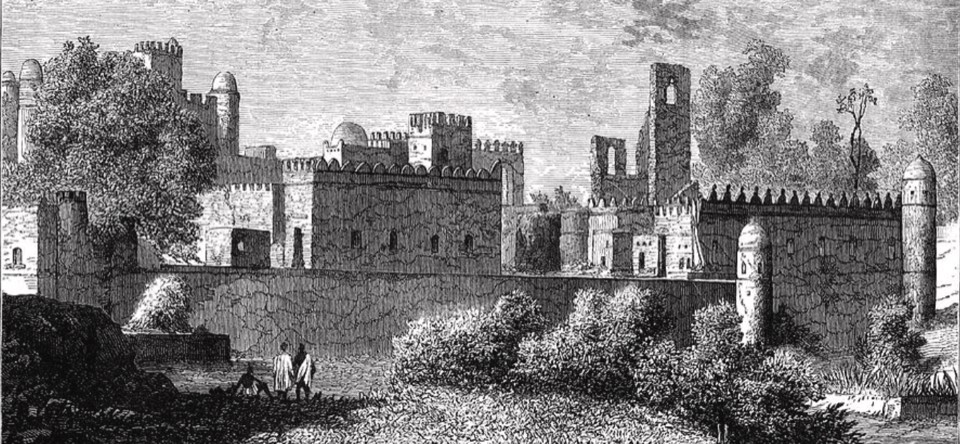
Traffic to Gondar picked up where the road intersected with the east-west caravan route north of Lake Tana, and by late morning they were riding through farms and large tent encampments of soldiers on the outer edge of the city. Soon the road split off in multiple directions, farmland giving way to small estates, blocks of residences, squares, plazas, and markets. Gondar was blessed with geographical good fortune: the protection of a semi-circle of mountain peaks; a reliable water source; abundant farmland; and its location at the crossroad of multiple ancient trade routes. It was the center of a broader region, connecting the Red Sea and eastern Ethiopia to Lake Tana and the southern provinces, as well as Khartoum and the northern desert kingdoms of Nubia and Sennar and the nomadic tribes who inhabited the regions of Kordofan and Darfoor, between the White Nile and the highlands to the west.
This influx of cultures was reflected in the faces, garb, and conveyances of the merchants, peddlers, artisans, and travelers going about their business on foot, mounted, driving or walking beside carts of all shapes and sizes, riding or guiding horses, donkeys, mules, and camels. Ethiopians were the great majority, but myriad African tribal groups, Egyptians, Arabs, Turks, Persians, Greeks, Armenians, Indians, Chinese, and a smattering of Western European faces were well-distributed in the mix. This fascinating aggregation of humanity, similar to but more diverse than what he knew in Emfraz, prompted Jonathan to pose the question that had been on his mind for much of the day.
“Selim, how shall I introduce myself on our voyage? Am I your friend, or relative? The bernos says I’m Christian, but am I Ethiopian or Portuguese… or either or both, depending on the circumstances?”
“Yes,” answered Selim. Jonathan smiled to himself at the predictable response. His guardian continued after a pause, during which he waved away a peddler offering them street food. “Here one would not question that you are Amharic, hearing you speak your language. That is who you are, but looking at you, one would probably see a European. Your skin is basically the same as mine, but your face and your features… your eyes and your hair…” he leaned back in his saddle and squinted at him. “Yes, you appear to be European.”
“What does that mean—does it complicate things?”
“Yes. People may wonder who you are, and what you are doing. Europeans travel, so it is not uncommon to find them around the world, but they are not always welcome. Their alliances change with the seasons, so it is good to know your kingdom’s history and the current state of relationships before you visit a foreign land.”
“I never had a problem at home. Is that because The Grotto has been owned by Portuguese longer than anybody can remember?”
“Yes, but Emfraz is generally open to outsiders. In some places, you will be hated as a colonist, an exploiter, and others will assume you have wealth, or that you come from wealth, and can be robbed or ransomed. When you get to Europe, you will find that they have their own prejudices… but here, in your homeland, you should remain vigilant.”
Selim paused as the midday bells pealed in a church tower somewhere ahead of them. “It is generally best to blend in and not draw attention to yourself.”
“Yes, that is my feeling, too, and why I ask. So… I am a European, and you are an Arab.”
“On the surface, yes. That doesn’t describe where we are from, however, and where you are from might get you enslaved, taken for ransom, or just killed in some kingdoms, and not in others. It is not a simple thing to look at a man and say he is Portuguese, but not Spanish, or Greek, for example, until he opens his mouth and reveals who he is.”
“Regardless, we are an unlikely duo, and neither of us appears to be from here, so outside of a place like Gondar, people will be suspicious of us… and what about when we go to the Levant?”
“These are good questions, Jonathan. In general, it is best to hew as close to the truth as possible—it is far easier that way. Here, we are traders and travelers, representatives of The Levant Company. You are from generations of Portuguese merchants from Emfraz; I am from Aleppo, and we know each other through our employer. Our donkey carries samples of your family’s wares, which we will sell in Gondar to pay for our trip, then we will travel to Aleppo, where you will work for The Levant Company.”
“Then I am not bound for the university, or even Portugal?”
“That worked for your friends, but the implication is that you have money. Remember, too, that the Portuguese component is problematic here, specifically, as well.” Jonathan nodded in agreement as Selim continued, “The short version ending in Aleppo is both succinct and plausible. Again, the simpler and more truthful, the better the tale. Anybody on the road who asks too many questions is a problem to begin with, and if they wish for further explanation, you don’t know anything—I am your escort, and all you know is you are headed to Aleppo. I will do the talking.”
Jonathan considered this for a minute. “Selim, speaking of truth, how has my father’s cover story held for so long? When doing whatever you and the others do for A Luz, do you just rely on a simple, somewhat realistic story and the ignorance of others to carry on this deception?”
“Yes, as well as your ability to avoid confrontation, hide in plain sight, or distract or change the subject with a clever diversion. If dogs are chasing you, offer them another scent. This skill is useful in other endeavors, as well, such as diplomacy, trade, governance, religion, or espionage.”
Gondar, the political and cultural heart of the Ethiopian Empire, was a magnet for goods and ideas from the rest of Africa, the Mediterranean, Arabia, Anatolia, Persia, India and the Far East. The renaissance that marked the reign of Emperor Fasiladas saw a revival of ancient Aksumite traditions—combined with Ottoman, Persian, Mughal and Portuguese influences—that produced the magnificent architectural marvels of the cosmopolitan metropolis that was now home to 70,000 residents. The scale of the monumental infrastructure, from the bridges and gates, the palaces, institutional edifices, churches, monasteries and even the streets themselves, had never failed to impress Jonathan on his previous visits with his father.
Emfraz and other cities were also endowed with grand urban architecture, but Gondar was—in his mind—the Platonic ideal of ‘the city’ and ‘civilization’, and for good reason. Fasiladas had intentionally built Gondar as his kingdom’s modern administrative hub and a monument to his own notions of progress, with an aesthetic that emphasized beauty and refinement, transcending the tradition of erecting temples and fortresses to simply express devotion and strength. Entering through the imposing Gate of the Judges on that fine afternoon, past heavily armed guards, they saw the greatest example of this—Fasiladas’ palace, or Fasil Ghebbi—towering 100’ towards the sky, its crenelated parapet flanked by four domed towers, all surrounded by massive stone walls.
Whereas the beauty and refinement of the visionary emperor’s plan was still apparent in abundance, this was a time of political instability, and the strength of the empire was on the wane. This was the first topic of conversation when Selim, Jonathan, and their host, Samuel, sat down to tea and a light repast after their mounts had been cared for and their rooms had been settled. Samuel and his occasionally overbearingly hospitable wife, Esther, ran a modest inn with a lush garden and tall shade trees in Kaila Meda, the Beta-Israel quarter of the city. They had become good friends of Joaquim, and Jonathan had spent many nights here with his father in the proprietors’ private wing.
“The Emperor is a captive in his own opulent palace,” said Samuel, shaking his head of greying hair. “Ras Mikael and his army surround the city. This has been the case for years, but with the passing of the Emperor’s great uncle last month, a civil war is brewing. Iyoas rules in name only… it feels like the calm before the storm.”
Jonathan was uncertain, and addressed his host, “We passed the camps and the guards, but isn’t it one thing to encircle a city, or even besiege it, but yet another to control the emperor and his government outside of Gondar? If Ras Mikael is really in charge, why does he not simply become emperor?”
“I don’t believe he wishes to be emperor,” answered Samuel. “He is crafty, and he controls Tigray. That is considerable power in itself, and perhaps he prefers to be kingmaker rather than king.”
“If he controls the Emperor, and he is Amharic, and the Emperor favors the Oromo, is this really just a tribal struggle?”
“In some ways, yes, Jonathan, but he doesn’t control the Emperor. That is a matter unto itself, and family is complicated. He is under the sway of the people he trusts. As complicated as family is, however, Ethiopia may be even more complicated… but I don’t know much of any of this. I just repeat what I have been told, and what I believe to be true… but your father would know this; he is…”
Jonathan felt a sudden desire to talk to his father, and a sense of deep sadness and loss washed over him momentarily. He realized he had missed what Samuel was saying, and from the corner of his eye realized Selim was watching him closely. ‘That man can read minds,’ he thought to himself.
“Mark my words,” Samuel continued, “chaos is just dawning on the Empire, and by the setting of the same proverbial sun, Iyoas will meet a fate none of his ancestors suffered: he will be deposed, murdered on the throne.” He looked grim and let out a tired sigh. “You will be traveling through Tigrayan country soon. You will see. The delicate balance is overturned. The roads are less safe because people are becoming desperate. They prey on traders and merchants, creating scarcity and higher prices, which only makes for more desperate people… many falling into servitude and slavery due to their debts. We will see famine… and the cycle gets worse, as the empire cannot collect taxes, and if it could, there would be fewer goods to tax. So, the people look to their Ras or their king or their local warlord for protection, and that further erodes the empire—continuing and quickening the whole bloody cycle—and as we suffer, the Ottomans move in. You wait, you will see.”
Selim nodded. “Yes, I saw poverty on my way to Emfraz, but I had nothing to compare it to. This tale you tell is not unique to Ethiopia, Samuel… similar changes are happening throughout the world. We are living through interesting times.” He turned to Jonathan as he spoke. “You will see much change in your life. It’s an interesting time to be alive… and it is even more interesting when you are aware of and understand what is happening in the world around you.”
They continued to discuss politics and world affairs for some time, then Selim went out to the garden for fresh air and yoga. Jonathan was deep in thought. How far he already was from his bucolic life in the hills above Emfraz, literally and in his interior. For the first time, he worried about his parents. What would they do if war came? It had occurred to him that he may be taken from them—the trip had its hazards, travel was dangerous—but he hadn’t considered that they could be taken from him. The reality of his choice—of Joaquim’s choice, to be more accurate—continued to become clearer. The journey had just begun, and he felt that it would be worth recording, so he borrowed an inkwell and quill from Samuel and began to write in his notebook, beginning with Selim’s arrival in Emfraz.
The following morning, Esther woke Jonathan very late. “Come welcome the day! There is coffee, fresh-baked dabo, and an assortment of fruit from our garden—even mangos!”
Selim was at the table. He had risen early, been to the Kaila Meda market, and sold their goods—including the donkey—to a family Joaquim had suggested would be open to the purchase. He seemed quite pleased as he relayed this news, but when Esther was finished fussing over the spread and walked away, Selim reached out and picked up the journal Jonathan had left on the table the night before.
“No,” he said quietly, but sternly, holding the book up in front of Jonathan’s face.
“What—why?!” Jonathan exclaimed, confused and a little taken aback at having been spoken to like a child. “I’m documenting my travels. What harm can that do?”
Esther looked up from where she was folding laundry across the room, then, seeing that it was none of her business, returned to her task.
Selim waved the book up and down, in a ‘lower your voice’ motion. “We do not do that. We do not track our movements or thoughts, except through reportage in service to our jobs or purposeful letters to friends—introductions, sharing news, inquiring about the well-being of family—as discretion is the key to secrecy, and secrecy is the key to our survival. We have never written down our beliefs, practices, and traditions, and we do not keep diaries. If somebody was after you, they could trace your steps and reveal everybody you met along the way.”
Jonathan was incredulous. It was one thing to discuss the secrecy of the group, but yet another to experience it on this granular level. He shook his head at what seemed like paranoia, and exhaled deeply, with more than a hint of frustration.
Although Selim recognized Jonathan as well-educated and possibly precocious, he still thought of him as a child. His actual business in Gondar was his final vetting of the boy. If he deemed his charge to be unworthy or unprepared for what lay ahead, or if Jonathan changed his mind, they were just a long day’s ride from Emfraz without the donkey slowing them down. Of course, a decision would then have to be made regarding preserving A Luz’s secret. It was possible the boy would be allowed to carry on the group’s Emfraz operations, but it was more likely he would be silenced. These were decisions for the elders—his role was to observe—yet he knew he would be called upon to facilitate or enforce the elders’ judgment, and he hoped to never have to receive an order like that again. He waited for his ward to follow up his exasperated sigh with a complaint, but instead, Jonathan opened the journal and carefully tore out the last few pages of writing.
“I understand,” he said, handing them to Selim, who folded the pages and placed them in a pouch on his belt and looked at the book in Jonathan’s hands, inquiring about it with his eyes.
“These are poems and observations from before I left home—from before I met you—and they reveal nothing specific of my identity or my family. If you will please trust me, I will keep them.”
Selim nodded his silent approval. This was the last time he questioned Jonathan’s will to follow through with his commitment.
They were saddling their horses when Samuel entered the courtyard between the stable and the inn.
“My friends, are you depriving me of your company so soon?”
“I have sold the whole of our stock already, including the donkey, and we must take our leave of your exceptional hospitality,” explained Selim. “The market was a cacophony of whispers, and I do not wish to be caught up in any trouble.”
Samuel nodded, a sad look crossing his face. “Well, I do understand. You are right, of course, but mind your back on the roads. Esther and I have nowhere else to go, and nowhere we would rather be. This is our home, and we will keep our heads down and weather these storms.” He looked at Jonathan. “You have grown to be an impressive young man, my boy—I know your parents are proud—and you are welcome here whenever your path takes you back through Gondar. May God be with you both.”
The three men bowed solemnly, and Selim and Jonathan rode north for Massawa, through the Gate of the House of the Chief of the Cavalry, then past the Ras’ soldiers encircling the city.
Generally pleasant weather, with mild temperatures and the occasional light rain showers typical of the late belg season, made for easy travel at a brisk pace on the well-worn track. Unencumbered by the donkey and its burdensome load, the first two days of the second leg of the journey passed quickly. Riding through bright green fields of young wheat, barley, teff, maize, chickpeas, and leafy green vegetables—idyllic and peaceful, lush with the seasonal promise of abundance—Jonathan was reminded of what he loved about his country, and what he was leaving behind. For how long he did not know. Perhaps forever. The thought had been squatting like a gargoyle in the back of his mind.
By the third day out from Gondar, the sense of pastoral timelessness slowly eroded, giving way to a countervailing uncertainty. They felt it creep in as they rested and watered the horses in the sleepy villages along the way, and as they passed small groups of soldiers headed in the direction from whence they had come, toward the capital and the emperor, seemingly powerless in his own city. The travel slowed and became more arduous entering the foothills of the austere Simien Mountains. The road itself grew rougher and the air cooler as they climbed, skirting the northwestern edge of the region’s highest peaks.
Camped above the village of Zarema, looking at the Zarima River and the dung and stick campfires that glowed like fireflies in the valley below, Jonathan reflected on the unraveling of the Ethiopian political and cultural fabric that was more evident traveling north from Gondar than it had been on the ride from Emfraz. Perhaps the political discussions with Selim and Samuel had opened his eyes a bit, or maybe it was just impossible to ignore the empty or dilapidated homes, broken fences, unplanted gardens, and the abandoned administrative building in the town below, where they had stopped to replenish their food supplies. They had asked for news, as they had in every village or town through which they passed, and although there was nothing said of ruptures to the tense peace in the capital, they heard rumors of sporadic violence elsewhere, spoken in quiet tones. Political alignments had begun to create fissures in regions, towns, and even families, and the telltale signs of migration and flux were clear.
On their sixth day of travel, Jonathan woke Selim as the struggling sun sought desperately to penetrate the thick grey clouds. It drizzled all day, and by dusk it began to rain in earnest. The pair sought shelter with their horses in an abandoned barn in the middle of an uncultivated field. Selim was unsettled—he called it instinct—and said they would not have a fire. The night passed without incident, but as they set out again in the rainy grey dawn, it was clear that his vigilance had not waned in the least.
“Why are you anxious?” Jonathan finally asked, growing more concerned as the hours passed.
“We were followed late in the day yesterday, and this morning I saw signs that a man had tarried by the road not far from us. He is curious about us, and I believe we will soon meet him.”
“How do you know this—beyond just sensing the danger, were you trained to track men?”
Selim turned to face Jonathan directly. “This is the most important lesson I can teach you in our time together: always be aware of your surroundings and always remain observant. Patience contributes greatly to the outcome of that posture. A degree of experience and common sense also helps,” he said with a slight upturn of his mouth.
“What exactly is it that you do for A Luz?”
“We all have different roles, and they are based on our true natures, as revealed through our training and initiation,” Selim explained. “The elders assign roles to the new initiates based on what the family needs.” He seemed momentarily wistful. “I ended up where I began, in the city of my birth. The time I spent in Sintra and Porto helped me to become who I was meant to be, and I was needed at home. I am thankful, though, to be able to travel… to help young men like yourself on their own paths.”
“How many have there been?”
“There have been others.”
He waited for more, but Selim was not forthcoming.
“But what is it that you do? You are a guide, and a soldier, I believe, and…” Jonathan trailed off.
“Yes, I am all of those things and more. Men like me are necessary. When you understand the history, the mission will become clearer. This is why we are going where we are going.”
He allowed Selim to ride with his thoughts for a while, then pushed further.
“Selim, we have been riding for a week, and you tell me little. I have to pry information from you. Somebody was always telling a story or discussing some subject in my home growing up.”
“I see. That is why you do not appreciate peace and quiet.” His subtle smile told Jonathan he was ribbing him.
“You know I do, but I also enjoy a good conversation. Can you tell me more of the Luzite’s history? I am not asking for more about the secret, but I have so many questions.”
”My job is to get you safely to your destination. Others will teach you the history. Your father gave you a good foundation for that, from what I have observed.”
“I just want to know what I am getting into, and listening to you talk to Samuel, you seem to know a lot more than you let on.”
“Political gossip is just fancy small talk. I know what I need to know, and if I do not, I learn. I keep my eyes open, and I listen. I know when not to speak, but I can always respond to what is said, and I know what men wish to hear. That is what you need to learn from me. Perhaps I am less Socratic, and I teach by example.”
Jonathan chuckled. “Very clever, Selim. I wish to talk, and your silence is justified as pedagogy. Tell me then, were your opinions last night just what you thought Samuel wanted to hear?”
He shook his head. “No, I agree with Samuel and have no reason to deceive him. It is generally best to listen in conversations like that. You will learn more. Now, keep your eyes open for a good place to camp. I would like a fire, but we need seclusion. A spot with one means of access would be ideal.”
The rain stopped, and the skies began to clear. The sun was sinking lower, yet no suitable spot was to be found, and the pair rode on silently through the late afternoon. Movement in the scrub brush on the side of the road ahead caught Jonathan’s eye. Expecting to see a tschelada monkey hustling away to a rocky perch, he was startled when a man appeared in the track directly in their path. Other than the sword drawn, extending from his side in a ready position, his features were unclear in the murky light of dusk. Jonathan’s first instinct was to turn, but in the time it took the man to appear, Selim was off his horse and in front of it, not five paces from the man.
The assailant stopped short and stepped back in surprise. Selim spread his arms wide and raised them, then slowly brought his hands together behind his head in what appeared to be a submissive posture. Jonathan could see that the gesture actually placed his right hand closer to the hilt of the gently curved sword slung across his back.
“Friend, you desperate and no evil,” Selim said in halting Amharic, slowly and quietly, “No pleasure for me to kill.”
The man somehow knew—as Jonathan knew—that the statement was not mere conjecture. It was a verbal warning that the certain outcome of any further effort on the part of the would-be brigand would be a quick death. How they both knew this, neither could understand, but it was absolute. The man slowly backed up, then turned quickly and ran back into the woods from whence he had come. Moments later, they heard him ride off at a gallop.
Jonathan had never faced a threat or attack like this. It felt as if the universe had abruptly sucked all of the air out of the world, and he exhaled hesitantly, wondering if his lungs would fill back up. Selim reached back and grabbed his reins, then proceeded towards the tree line on the side of the road where the man had been hiding. Jonathan dismounted and followed wordlessly, his heart racing. The reality of their vulnerability and exposure had not been fully realized until this point, and his abstract notion of ‘danger’ had been clarified and grounded in experience for the first time.
Behind the trees lining the road was a grassy clearing abutting a trickle of a creek. This was a good spot to set up camp. They unsaddled their mounts and tethered them with long leads, so they could graze.
“Now we can build a fire. We have nothing to fear from him, nor shall we see him again,” Selim said with calm certainty.
They gathered damp sticks from a fallen tree, and with some effort, built a small, smoky fire. After a simple meal and a cup of hot tea, Selim lay back on his blanket, head resting on his backpack, and stared up at the stars.
“Were you worried?” Jonathan asked finally, breaking the silence.
“I am always worried, but I know how to push it away. What did you feel?”
Jonathan thought for a moment. “My first instinct was to flee— I guess I feel like a coward, but I have never been challenged like that before.”
“That is not cowardice. That is sensible. Some people run from a burning building; others rush in to see if they can save somebody.”
“I would like to think I am the kind who would help, but…”
“You will find out, but this experience should not be your benchmark. With your inexperience and not knowing my capabilities, flight was prudent.”
“What if I am a coward?”
“That would be a terrible thing, but I sense that you are not. Running from danger is not cowardice. Self-preservation is always wise. Neither response is wrong, and in any case, we cannot change our natures.”
After a moment, as Jonathan considered his words, Selim continued. “How do you feel now?”
“Wide awake. Alert.”
Selim nodded. “Good.”
They watched the fire and listened to the night sounds around them. A thought that had been on Jonathan’s mind for days now begged for attention.
“I have been thinking about what would have happened if I had refused to come along.”
“You would not have known,” Selim replied after a pause.
“Well, I can understand you were confident in my father’s judgment, but what if both he and you had been wrong, and I had refused—what would you have done?”
“You would have never known,” repeated Selim. “You would not have seen me coming.”
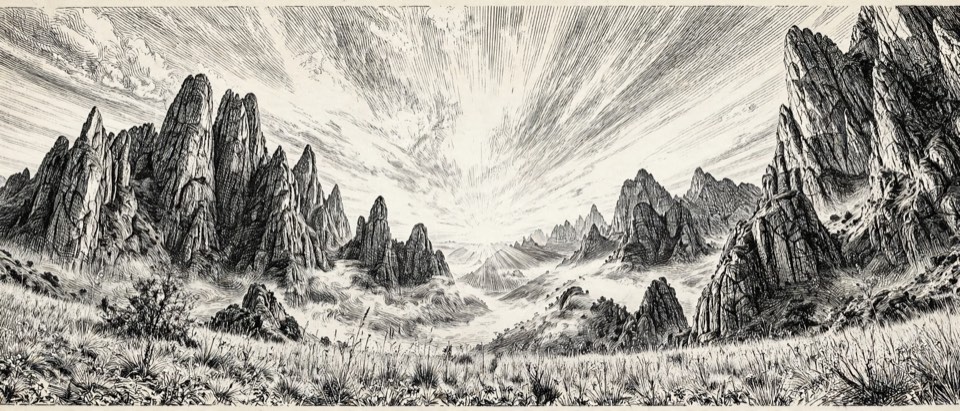
The Rosy Fingers of Dawn
April 27, 1767 ~ The Road to Axum, Ethiopian Empire
It would soon be light, and Selim was tossing and turning in his sleep, as was often the case. Jonathan stoked the fire and sat still on a rock, taking in the early morning. He was reminded of Homer’s mnemonic device in which many chapters began with a description of the early morning sky as ‘the rosy fingers of dawn’.
‘Indeed’, he thought, looking out over the landscape. The rosy-fingered dawn reached towards the sky from the dark silhouette of the Simien Mountains’ jagged profile. Jonathan imagined Odysseus and his crew in… what was Odysseus’ ship called? ‘It didn’t have a name,’ he thought. ‘That’s odd. It was such a central feature of the journey. Jason had the Argo… why didn’t Odysseus’ ship have a name, too?’
He heard Selim fart in his sleep, and he let out a little snort of laughter. One of those two things woke Selim, who then proceeded to slowly rise from his bedroll. He stretched his arms and yawned, now framed by those same rosy fingers of dawn.
“It looks good on you,” said Jonathan.
Selim ignored the comment, having heard enough random thoughts escaping Jonathan’s mouth over the last six weeks to no longer be confused. Although he did not let on, he appreciated how the young man’s mind worked. Selim was not averse to frivolity; he just hadn’t had much experience with it in the last 20 years. He had also just woken from a troubling dream and was still a little foggy.
Jonathan untied the horses and led them to the stream, letting them roam freely while they broke their fast and prepared for another day in the saddle.
“Will you teach me to fight, so I don’t have to run from a bandit?” he asked after they had gotten underway.
“Sometimes it is better to run from a bandit. I will teach you to know the difference.”
Unsatisfied with the response, he pressed. “But I would like to be prepared for both options. I am already a very fast runner, and a good horseman.”
“Dismount,” Selim commanded, and he was quickly on the ground, stripping off his pack and scabbard, then his robe, leaving them in a pile on the track.
Not expecting this sudden movement, Jonathan hesitated, then got off his horse.
“Stand like this.” Selim adjusted his footing so his feet were spread a little wider than his shoulders, and raised his hands over his head in a wide arc from his sides, then brought them together as if in prayer. Maintaining his position, he eased into a partial squat as he brought his hands—still together—down to the middle of his chest, stopping at the solar plexus as he exhaled purposefully.
Standing upright again, he instructed Jonathan to emulate him as he repeated the movement and told him to hold the pose—back straight, focused on his breathing—until he could feel it in his thighs.
“I served with a man from Cathay. He showed me what he called ‘forms’—a series of stances, punches, and kicks. This one is called ‘horse stance’. He taught me very little—it was forbidden—but I will teach you what I know. You will do this with yoga every day. These are our exercises.”
“How does this help me to fight?”
“The exercises are for balance and intentionality of movement. They are a discipline. You will need all of that to fight. I will teach you one stance at a time. When you have mastered it, I will proceed to the next step, and not until then. There are five stances to learn before we work on strikes.”
“If this is just one of five stances, then I will learn to do it well so we can get to the next one,” Jonathan said.
Selim shook his head. “I told you this training is for balance and intentionality of movement. You do not understand intentionality. The purpose of doing the stance well is not to move on to the next one—it is to master the one you are working on.”
He donned his cloak and backpack, slung his sword across his shoulder, and mounted.
“This will take time. Now, we ride.”
Jonathan stood watching Selim slowly continue down the dusty track, then repeated the stance, careful to keep his back straight, and concentrated on how his body felt as he went through each step. He had not expected the incisive philosophical jab, and it had landed.
“You said there are many different roles in A Luz, some of which are for soldiers,” Jonathan said after they had ridden awhile. “Why do we need fighting men?”
“As it appears I will never have peace unless I indulge some of your questions, I will simply tell you the Luzites found themselves in an untenable position early in their history, and it inspired the more bellicose members to establish a defensive element within the group. They could not field an army, but they could create fear in their enemies, and trained some members in martial skills to protect the family. We still do this, but as they were a small group, assassination was the chosen path, and as they possessed ancient knowledge of plants and medicine, poison was the vehicle. That did not go as planned, but poison remains a viable option.”
“I am not certain I see the honor in that approach,” Jonathan said cautiously.
“There is no honor in killing.”
“But sometimes it has to be done, and is it not more dignified for—”
“Do not seek dignity in warfare.”
Jonathan was excited to pursue this topic as long as Selim would engage, and thus far he was getting more than he expected from his reserved Arab guardian.
“What about self-defense, is it honorable?”
“That which is necessary is not made ‘honorable’ or ‘good’ by virtue of need. You have romantic notions of heroism and glory, but even in self-defense there is seldom much of that, as self-defense is too often an excuse for aggression.”
“If the result is self-preservation, then what is the problem?”
“The issue one must contend with is intentionality, as I said before. Contemplate that as we enjoy the scenery and be aware of my intention to leave you beside the road if you persist with these philosophical questions before you have explored the idea of intentionality.”
Selim looked dead serious, then cracked a small smile. Jonathan laughed—he had finally dented the man’s armor.
“Is that what you did with your previous charges?” It was half in jest, but no sooner was it uttered than he regretted it. Selim’s expression changed, and he looked away.
“I do not make many of the decisions, and those whom I escort have agency. They make their own choices,” Selim finally replied, with an unexpected bitterness in his voice.
They rode along in silence for hours and stopped at a small village for provisions in the late afternoon. An hour further, they found a quiet bend in the river, concealed by a row of trees and low brush. Within the curve of the oxbow, there was a grassy patch, and at the apex there was a spit of sand at the base of an outcropping of rock. An ideal spot to camp. Jonathan had felt bad about the palpable tension all day, and—after a hot meal—tried to engage in small talk. Selim was not impolite, but he wasn’t conversational, either, opting instead to bathe in the river and wash his clothes.
The sun was now an orange wedge between two distant peaks that looked like the humps of a Mongolian camel, Jonathan thought as he gathered more wood for the fire. Selim whistled while he washed, as was his habit. A wolf howled, and was answered by others, seemingly just as far away, but coming from many directions. The highlands are home to a number of animals who could be a problem for a lone man on a quiet stretch of road—baboons, hyenas, jackals, even the occasional lion—but wolves were not a real concern, and most animals would not attack two men unless they were starving or cornered.
Despite knowing this and having spent many nights sleeping outdoors in the mountains around Emfraz, Jonathan found it unsettling. He put more wood on the fire as the sun slipped from view, ‘to better illuminate the camp and the surrounding brush, not to keep wolves at bay,’ he told himself. Now a silhouette just outside of the firelight, Selim was dressing and rummaging through his saddlebags. He stepped into the light, brandishing a pistol, which he placed on the ground by his bedroll.
“I did not know you carried a pistol,” said Jonathan, more as a statement of fact than surprise.
“I have never been bested with a blade, and prefer one to a gun,” Selim replied, taking a seat by the fire. “From a distance a gun has its advantages, but at close quarters, I can more quickly be on a man than he can level, aim, and fire at me with accuracy.” Jonathan pictured that scenario and nodded.
“I have my pistol at the ready if we are visited by whatever those wolves are fretting about.”
“May I ask you a question?” Selim nodded yes. “Where did you get the scar?”
Jonathan knew he might be treading on shaky ground, particularly after the blunt, possibly insensitive comment that shut Selim down earlier in the day, so he was relieved to see in his reaction that this was not a sensitive topic.
“I met a man who was better than me, and it is by good fortune alone that I have this scar. His luck ran out that day, because I am here to tell about it.”
“How? You said you have never been bested by a blade?”
“I have never been bested, but I have been tested. We fought for a full minute, back and forth, with stone walls that had been battered by cannons crumbling around us. I was exhausted, terrified to have met my match, and falling backwards down a flight of steps when his blade slashed me. Had I not already been falling when he swung his blade, my head would have been split like a melon. As I fell, and as his sword completed its arc, he was crushed by a collapsing wall.”
Jonathan looked to see if Selim was having fun with him. It was the most descriptive narrative he had heard from the man, and he assumed it was some sort of fiction with a moral. “Really?”
“Yes. It was war. Good men killing each other for bad reasons. Death isn’t always exceptional, or heroic, or even fair—whatever that means—sometimes it is as easy as falling from your horse.”
‘Every time Selim opens his mouth to answer one of my questions, more questions emerge,’ thought Jonathan. A wolf howled nearby and was answered immediately by other calls, the yipping and low barks of a pack keeping track of each other.
“They are around us, much closer, and they know we are here,” Selim said calmly. The horses whinnied in agreement, albeit less calmly.
“What should we do?” Jonathan asked, revealing a little more concern than he intended.
“We wait,” replied Selim without hesitation or fear in his voice. “The wolves are no threat to us. They spotted something they didn’t like earlier—most certainly men—and they are spreading the word. We have a good spot here, with the river on three sides. Although it is low, and would be very easy for them to cross, it presents a barrier, and it makes them vulnerable. They would have to approach from the road, through the trees and brush. We would hear them if we didn’t see them.”
“The wolves?” asked Jonathan.
“I am not afraid of wolves,” Selim replied calmly, abruptly standing up from the fire, pulling on his boots and slipping his cloak over his shoulders. He stuffed the pistol into his belt, grabbed the bedrolls, and brought them to the saddlebags, pushing all of it further into the underbrush. Slinging his scabbard over his cloak, he walked quickly to the horses, speaking quietly and calmly to Jonathan as he untied them. “Put out the fire.”
“What? Why wou—” Jonathan began in protest, then saw the serious expression on his face and moved quickly to extinguish the fire while Selim led the horses across the shallow waters and tied them to a tree on the other bank. Jonathan retrieved his kukri and battle belt, adrenaline flowing and senses now heightened. The smell of smoke was dissipating, and he noted the breeze was blowing to the north, away from the direction they had come. ‘That is good,’ he thought to himself. A wolf barked, and was answered by the rest of the pack, further away this time, and receding to the west. The howling and yipping gave way to the unmistakable sound of men marching. Selim looked at Jonathan and nodded, pulling his hood over his head and disappearing into the shadows of a clump of trees. Jonathan followed suit, wrapping himself in his dark bernos, pulling the loose cowl up over his head, and wishing he had a full cloak with a proper hood as he curled around the base of a low tree surrounded by brush.
Barely discernible beneath the stars as a shifting shape in the darkness of the nearly new moon, a group of men marched down the road, not concealing their movement in any way. They passed noisily, unaware of the presence of others in the bushes, and were soon out of earshot.
“That was dozens of men.”
Selim nodded. “You take first watch.”
Jonathan heard the wolves again, much further in the distance, and thanked them for their alertness.
The sound of riders rapidly approaching shocked Jonathan into wakefulness. Rolling over, he saw Selim saddling his horse across the creek, and sprang to his feet, grabbing his cloak, bedroll, and bag. He was at his side in seconds. They were mostly hidden from the road, but with dawn breaking upon them, their only hope of being undetected was the speed and noise of the horsemen themselves. Jonathan ran back to the bushes for his saddle.
“It is good to see you move quickly,” said Selim, watching him saddle his horse and secure his bag and bedroll. “You’re learning. Always be prepared to move.”
The riders were a couple of hundred yards away now, kicking up clouds of dust as they cantered closer.
“Act as if we belong here. We cannot hide, so we should not look alarmed,” Selim commanded, securing his sword to his saddle and covering it with his cloak. As he led his horse back across the shallow river, Jonathan noticed the pistol stuck in his belt, behind his back. He followed suit and joined his guardian as more than a dozen horsemen rode past, sabers at their sides and muskets across their backs, barrels beneath the peaks of their bernoses. They did not wear uniform dress, nor was there insignia on the shields of those who carried them. Apparently in a hurry to reach their destination, they saw Jonathan and Selim but didn’t slow for a closer look.
“I think these are Ras Mikael’s men—they don’t look like the emperor’s cavalry.”
Selim nodded. “We’ll follow at a distance.”
They waited a couple of minutes, then got on the road at a canter of their own, staying just behind the lingering dust cloud in the riders’ wake. They rode this way for about an hour, when suddenly musket fire erupted ahead of them. Selim motioned to Jonathan to follow him as he cut into a field, riding towards a walled farm compound at the bend in the road ahead. They stopped and dismounted in an overgrown orchard, close enough to hear the clash of swords and men yelling.
Squatting for cover at the edge of the orchard, Jonathan viewed the battle scene in front of him. It appeared offhand that the horsemen had attacked the other group—the Emperor’s men, he could see now, most likely those who had passed in the night—as they were breaking camp. Four or five tents still stood, while the rest were on the ground, awaiting folding and stowing. Men and horses lay in the dirt, some screaming, others gasping or silent.
The individual struggles came into focus, and Jonathan watched a grey and white mount struggle to get to its feet, a spear broken off deep in its blood-soaked chest, with a man still attached to the poor beast, foot stuck in the stirrup, being jerked forward with the horse’s desperate lurching efforts. Another man lay screaming on the ground, only to have his head split by the blade of an imperial soldier.
A shot rang out, pulling Jonathan’s eye instantly to the left. He saw the puff of smoke trailing from a horseman’s musket barrel as a man crumpled yards away. Three men were hacking at another cavalryman’s mount and legs, bringing them both down. They continued to slash and jab at the helpless man who was trapped under the dying horse. It was a terrible, brutal scene, shifting and swirling in dust, gore, and flashing blades whose every arc created a fresh spray of blood. The noise was even worse, however: the high-pitched screams of terrified horses, the dull thwacking sound of metal striking meat, the pitiful cries of men suffering in mortal pain, calling out for their God, their mothers, their wives, gurgling curses and sharp, gasping, dying breaths.
The fighting was over in minutes. Three of the riders managed to haul themselves into their saddles and escape, as the Emperor’s men walked among the wounded—some whimpering and pleading for mercy—jabbing spears and swords into the helpless bodies, twisting, pulling them out. As the initial shock wore off, Jonathan was filled with revulsion and anger. He turned his eyes to the ground to hide the tears streaming down his cheeks. He had watched a man hang when he was a boy, and two summers past he had seen a man killed by a hippo in the lake. He had participated in the slaughter of many animals. He knew and understood death—violent death—but he had never seen such cruelty.
He looked up again and counted eleven men left standing. Three others appeared to be critically wounded, but alive. Four of the soldiers were attempting to round up the remaining horses, as the others tended to their wounded comrades who moaned and cried out in pain. A man threw up a ghastly black mass, then collapsed, blood now flowing freely from his mouth. The soldier rendering assistance looked about him, then removed a pouch from his dying comrade’s belt before joining the effort to capture the horses. The man on the ground lay still. Jonathan felt Selim’s hand on his shoulder, wondering how long it had been there, and turned to face him.
“Why?”
Selim looked at him with compassion in his eyes but said nothing in response. What was there to say? They quietly backed away from the aftermath of the fight and rode slowly through the orchard and another adjoining field, maintaining a wide berth, before getting back on the road.
“We’re close to Adwa… the Emperor’s troops will return there, having lost most of their force,” Jonathan suggested. “Ras Mikael’s surviving horsemen could have ridden for reinforcements from Adwa or headed for Gondar to tell their comrades of the battle… but who was following whom, and why?”
Selim shook his head. “It makes no difference. We are not safe with either party, and we do not belong here. You are Ethiopian… but they will see Portuguese, and you ride with an Arab. This is no longer a safe road, and this is not our fight… it is our flight.”
They were exhausted, and neither spoke much. They had spent the last eight days traversing a variety of terrain on inconsistent roads, and the journey was catching up to them. Each day was a challenge. They slept in shifts and were on the road shortly after dawn for ten to twelve hours in the saddle, only broken up by resting and watering the horses, or walking them when they tired. They set up camp before the sun set. Meals were inconsistent, depending on what they were able to purchase in the small towns through which they traveled, and although they had a hot meal most days, there were plenty of meals—hardtack and dates, apricots and foraged plants—eaten in the saddle. At waterholes they topped off their goatskins and drank their fill.
Little was said for hours. They took a break among the terraced farms and pastures surrounding Axum, and decided to ride right through the ancient city, prepared to turn into a side street if they encountered soldiers. The skeletal remains of a great civilization took shape around them in the shimmering midday sun. Ancient ruins and monoliths to faded glory rose from the earth—rough, irregular stelae showing their age on worn edges and obelisks stretching to the sky, remembering a great battle or a great king—like fingers from the past pointing to nearly 2000 years of history. Once a thriving city at the crossroads of the gold, ivory, and spice trade routes that connected the Mediterranean Sea and the Indian Ocean, Axum was now but another crumbling relic on the way to the Red Sea.
Selim pointed to a square, fortress-like building with a dome in its center. “That is the Church of Saint Mary of Zion. It is said to contain the Ark of the Covenant.”
Jonathan nodded. He knew this, as did most Ethiopian children. By way of these very trade routes, the Jews had come first, followed a thousand years later by the Christians in the 4th century. This was the place where emperors were crowned. Normally, he would have been gushing with excitement and leaping at Selim’s overture to a conversation about the ancient lore of his homeland, but his enthusiasm was overshadowed by the foreboding that came over him as he took in the cityscape. The decrepitude had come as a surprise. He understood Axum had long-ago ceased to be particularly relevant, but seeing the shell of the once-great city weighed heavily on him.
The Axumites had collapsed, he recalled from his studies, under the pressure of cascading issues: the seizure of its Red Sea ports by the regionally ascendant Persians, followed by the later Islamic powers; the ensuing weakening of the trade routes that fed these ports; the loss of revenues to maintain the empire and its armies; over-farming, drought, and the inevitable hunger—then migration—resulting from this agricultural collapse. The influx of hostile tribes into the region, in response to immigration pressures on their homelands, had finally tipped the political instability into the infighting that stemmed from the weakening of the central powers.
By the middle of the 10th century, the mighty Axumite Kingdom was no longer. It had been interesting to study, particularly as it was displaced in any tangible notion of time, but being amongst the ruins—here where it happened, beneath his feet and on the stones he could touch with his own hands—Jonathan felt the immediacy of the collapse and felt as if he was inhabiting the history through which they rode.
“It’s sad to see this, Selim. I can picture the people here, caravans coming from every direction—like Gondar—and seeing what it looks like when things fall apart, I can imagine what Emfraz and Gondar will look like in the future… dried-up husks. I know terrible things happened in history, but knowing something in my head is not the same as knowing it in my heart. I honestly can’t even think of what I thought I knew barely more than a week ago… it’s like a veil has been lifted. We are riding through these changes… they are no longer conjecture. The comfort of my home and the familiarity of Gondar prevented me from seeing… as if privilege bred ease and contentment to protect itself.”
The streets of Axum were relatively quiet. There were a few people gathered in the market of empty stalls, and a small assembly in a church courtyard, but the town felt entirely subdued. Fortunately, there was no sign of soldiers, and the travelers quietly made their way through, not slowing or even looking around, for the most part. Selim remained silent. The boy had a way of retreating to his book learning, and he was beginning to see its limits. Nothing he could offer to explain the flash of self-awareness would make it less uncomfortable.
“I’ve always wanted to see Axum,” Jonathan said with a tinge of bitterness.
“Now you’ve seen it,” Selim responded dryly.
They proceeded at a brisk pace, hoping to get well past Adwa, the de facto capital of Tigray, before nightfall.
“Insurrectionists, rioters and mutineers are most emboldened right before they strike, and the Ras’ men are feeling their power. I want to be far from their nest when the hornets emerge,” Selim said as they approached the city in the early afternoon.
There were no monolithic vestiges of an ancient civilization to greet them. The farmland simply transitioned to a large, sprawling city that bustled with activity, but had nothing of Gondar’s charm or grandeur. Both were the beneficiaries of geography, however. As Gondar’s strategic, defensible location at the junction of major trade routes had made it the perfect location for a permanent capital for the empire, Adwa’s spot at the halfway point between Ethiopia’s main port in Massawa and the seat of empire in Gondar made it the perfect place to charge a toll on every wagon or caravan that passed through.
The checkpoint was crowded, and they walked slowly forward, leading their mounts and silently listening to the chatter around them. There was buzz about a battle that cut through the mundane discussions of the weather, the market, and local gossip.
“The guards will be on edge,” warned Selim. “You speak—it is your country and your language. You are an Armenian from Emfraz, Hovnan Grigorian. I am your guide, Selim. We are due in Massawa for a ship to Aqaba. Nothing changes but your name, Hovnan Grigorian—it is on the papers.” He surreptitiously handed over a wad of paperwork.
Jonathan felt his head spin. There was no time to think or ask questions, however. They were at the gate and a guard—a young man around his own age—approached aggressively.
“Who are you? Horses?! This way!” He pointed and shoved Selim—who was closer—to the side of the road, as two other guards stepped forward to take his place, one focused at a short distance on his comrade’s questioning of Jonathan and Selim.
Selim raised his hands meekly and looked to Jonathan. His sword was lashed to his saddle, out of sight on the opposite side of his horse and mostly covered by his cloak. Jonathan had not even seen him do that as they waited in the crowd, but the blade would soon be discovered.
“Hey! Leave my man be!” Jonathan hissed at the guard. “Here—” he thrust his papers at him and watched as he unfolded and looked at the letters without any sign of understanding on his face.
“Where are you going?”
“Massawa, to meet Ras Welde Leul’s new secretary and bring him to Gondar—it says so right there, and we are pressed for time. Get a move on, man!” Jonathan’s demeanor was disdainful, his body language almost aggressive as he got right in the young guard’s face and snatched the papers away.
“You cannot read, anyway.” He turned to Selim. “Come!”
The guard seemed uncertain and looked back towards his friends, but they were nearly overwhelmed by the press of people seeking to get through the checkpoint and into the city. Jonathan started forward, leading his horse with Selim in tow, as the guard turned and walked back to his post.
“What the hell was that?”
He looked at Selim with a scowl of his own. “Had you given me a moment to prepare, you would have had the opportunity to coach me,” he said as he handed him the papers. “I saw immediately he could not read, and I didn’t see anybody else handing over paperwork. I decided he was too busy to really engage—he just wanted a bribe—and I wanted him to see it was not worth the time.”
“That was foolish,” Selim said, shaking his head.
“He didn’t expect it either,” Jonathan retorted quickly, “and here we are, on the other side, and he’s back there.”
Selim chuckled, still shaking his head.
The travelers continued unmolested through the city and out the other side. The packed density of Adwa gave way to small estates, then pastures, and traffic on the well-travelled road out of Adwa thinned as they rode aggressively north. They made it to a river crossing before sunset and rested alongside the banks where the horses could drink their fill and graze. The river was low, the grass parched, but as they followed the horses downstream, Jonathan spied a dilapidated farmhouse with a walled courtyard. They rode up cautiously and determined that it was abandoned.
“Good eyes,” Selim grunted as he tied a rope across the opening where the gate had been, penning in the horses.
“I found a well,” Jonathan announced from behind the crumbling house. The mud mortar holding the stones together under the sagging roof was mostly gone, but the well looked sound, and to his surprise, there was a new rope on the bucket and two wooden bowls on the rim of the well. He brought a bowl of water to Selim, telling him of the well’s condition.
“I’m not surprised. A well is a valuable asset. We aren’t the first people to spend a night here this week, even,” he said, pointing to a fire-ring with charred wood and a broken pottery jug. Selim smelled the well water, poured it over his hands, then licked at the water dripping off. He drank cautiously from the bowl. “It’s fine. Please fill our bags, drink your fill, then water the horses. I’m going to rest. You have first watch.”
“It’s a new moon. I’ll build a fire,” Jonathan offered as Selim laid his bedroll on a stone dais in a corner of the weed-choked courtyard.
When the fire was lit, casting its shadows on the walls, Selim sat beside him to watch the flames.
“Is the whole world doing this?” Jonathan kept his eyes on the fire, giving air to his thoughts. “Is this why A Luz has called on me, to help navigate the… the chaotic muddle the world is in? Are we about to serve this greater purpose my father would speak of?”
Selim shook his head slowly. “No, Jonathan—it isn’t that simple. The greater purpose is right here, at this moment, and for all the moments you move forward. You served that purpose when you agreed to go down this path.”
“You haven’t answered the question: is the rest of the world experiencing the same turmoil as this, as you were discussing with Samuel?”
“There is always chaos, and it doesn’t always look the same, but yes—it does seem that most of the world is experiencing some kind of realignment, or perhaps an awakening of sorts… but it’s difficult to wake up when you believe you’re already awake,” Selim said into the fire.
They crossed the Mereb in mid-morning, over the traditional boundary of Tigray and into the Kingdom of Medri Bahri—a political hinge between Constantinople and Gondar—and a geological transition from the highlands to the Rift Valley. Descending from the high plateau, rivers snaked westward, leaving carved channels across the landscape, and odd formations of volcanic rock jutted upwards, often flattening into steep-sided plugs framed by the jagged, toothy edges of the mountains all around them. Transitioning to the lower elevations of the Tigrayan plateau, the scenery shifted from the dramatic mountains and arid plateaus of the Ethiopian highlands to the rolling hills, green valleys, and—as they approached the town of Dbarwa—farmland stretching in every direction as far as the eye could see.
Much like the broader Ethiopian Empire and the Kingdom of Medri Bahri, the city of Dbarwa itself was in decline. Eclipsed by Adwa as a regional trade hub, Dbarwa still served as an important regional market, and the travelers stocked up on enough supplies to get them to Massawa. More importantly, they found a room at an inn with a stable where the horses could get some attention to their feet, a good brushing, and some quality feed. The horses were not alone in needing attention to their needs, of course. The men bathed, washed their clothes, aired out their bedding, and ate a hearty, leisurely evening meal before retiring early in actual beds.
The rest in Dbarwa was much needed. It sustained them through the final push for Massawa as they descended from the fertile highland plains towards the Rift Valley. They had spoken little for days, and when they did, it was casual, functional conversation—where to camp, the weather, the scenery—but Jonathan noticed a gradual change in Selim’s demeanor. He had softened a little, and his conversation was less curt and guarded.
They did their exercises side-by-side, in silence, every evening after supper. Based on Selim’s encouraging guidance, it seemed to Jonathan that he was progressing quickly, and it felt on occasion that they traveled more as companions than as a guardian and his charge. The road took them through a new stretch of rugged mountainous terrain and snaked between steep-sided, flat-topped hills called ambas—or “mountain fortresses” in Jonathan’s native tongue—and it only took looking at them to understand why.
From their position on the high plateau that formed the western slope of the valley, the Red Sea glimmered in the morning light, pierced by the stretched reflection of the rising sun. A ribbon of green faded into desert that rose gently to the base of the rocky escarpments. They had set out in the dark, hoping to make the descent in one day. Ahead of them lay a dramatic downward plunge into a series of cliffs and shelves—like a staircase for titans—that needed to be traversed on foot by way of steep, rocky switchbacks.
Massawa was tantalizingly close all day, but after cutting back parallel to the coastline, it became clear to Jonathan that this would not be a quick ride to their goal. They finally came to the valley floor late in the afternoon, after twelve grueling hours on perilous terrain, and they—like their horses—were utterly exhausted. From above, the floor had appeared to be desert, and the shrub-speckled, bone-dry, spiky grassland that stretched before them was not far from that, and brutally hot, even as the day was drawing to a merciful close.
Their route took them to a road that skirted the Obel River, a tributary of the Mareb, which they would follow northeast to Dogali, before heading due east to Massawa. Selim spotted a good location for them to camp on the river bank, behind a cluster of scrub brush and a few shaggy doum palms, some fifty yards from the road. They tied the horses close enough to the river, so they could drink at their leisure, and went about the familiar routine of setting up camp. Having bathed and eaten, they sat in the firelight, and Jonathan asked the question that had been bugging him since they stopped at the river.
“We’re less than two hours’ ride from Massawa—we could be riding into the city right now—why did we stop?”
“We need to discuss the next leg of the journey. Massawa is under Ottoman rule—the governor, or Na’ib, is a functionary of the Porte.” Seeing the question on Jonathan’s face, Selim explained, “there is the Sultan, and there is the Sublime Porte. It’s the government. It’s Constantinople… the rulers and their functionaries and civil servants, carrying out or carefully curating the will of Sultan Mustafa III.”
“I see. The trusted, trustworthy advisors. The men with money, power, and agendas of their own,” Jonathan said with a little smirk.
“I appreciate your budding cynicism. It is the partner to idealism in a healthy mind,” Selim said with a chuckle, but all laughs aside, it gave him hope that the young man would survive the ordeals ahead, known and unknown. He was coming to respect and care about Jonathan, as opposed to simply caring for him.
“Yes, that is how it works, and the Na’ib serves the Sultan while paying tributes to Emperor Iyoas for protection. He probably pays the King of the Sea, as well. The system works—Massawa is a safe, thriving port partly due to this shaky political arrangement,” Selim said as he retrieved the folded papers from his belt pouch and waved them in front of Jonathan. “We should expect to be interrogated, and the Na’ib’s soldiers are vigilant, but we may pass through unnoticed in the morning crowds. If we are stopped, I will do the talking. I am your guide, and we are bound for Aleppo.”
“That seems a little bit thin, Selim. What do those papers even say?”
“They are from a friend in Aleppo, whom you will meet, requesting passage on behalf of The Levant Company for myself and Hovnan Grigorian.”
“Yes, so I am told,” Jonathan replied with a bit of sarcasm. “It would have been good to know that before I needed to, on the spot, in Adwa.”
“Indeed, and I apologize,” Selim said. “It is time to sleep. You have first watch.”
There was no stopping Selim when he was ready to sleep, and soon he was snoring quietly. ‘Amazing,’ Jonathan thought to himself, ‘that man can just lie down and immediately be asleep. I would love to have that ability.’ Moments later, he opened his eyes in a panic. He couldn’t breathe—Selim’s face was inches from his, eyes blazing, and his hand was covering Jonathan’s mouth and pressing his head back into his saddlebag. He realized, horrified, that he had fallen asleep. The irony of his last conscious thought about Selim’s ability to fall asleep made him a little sick. He grabbed his wrist and felt the grip relax. Selim motioned towards the road, and the sound of men moving quickly in their direction through the brush.
Two men burst through the scrub into the moonlit clearing, side-by-side, swords drawn, followed by three others steps behind. Selim, barefoot and clad only in a loincloth and grey tunic, with his belted sheath slung across his back, moved with a quickness and agility that startled Jonathan nearly as much as it startled the last three men standing alive long enough to witness it. Pouncing like a lion in hiding from his crouch at Jonathan’s side, he landed within feet of the attackers, and—in one deft motion—his right hand passed over his head and pulled the blade from its sheath as he shifted his balance to the left, in advance of the arcing steel that disemboweled the first two men in one sweep. Now following the blade’s trajectory, as if pulled by its weight, he spun on one foot and ended his sword’s path in the solar plexus of the third man who tried to inhale, not yet realizing he had been skewered. Turning his wrist, Selim shifted his weight again and—while pulling his blade from the sagging body—he drove his dagger into the throat of the fourth assailant, just as the last man finally cleared his blade from its scabbard. He, too, stood no chance at all. Selim then turned and plunged his dagger into the throats of the first two, silencing the cries and moans that had momentarily filled the night air while their guts spilled from their bellies onto the ground.
Selim squatted, unmoving, facing away from Jonathan. Five men lay lifeless around him, effortlessly dispatched in seconds by a man who would rather have passed the night in peace. He listened for sounds from the road and heard only the soft murmur of the river. Satisfied that they were in no immediate danger, he wiped his blades on the robes of a corpse and stood, raising his blood-streaked face to the bright light of the golden half-moon high in the western sky.
“I am covered in blood. Go to my bag and retrieve a fresh tunic and breeches, then pack everything but my sandals, saddle the horses, and prepare to leave. Do not touch these men.”
Jonathan had barely gotten to his feet by the time Selim was through with his gory task. The initial shock had worn off, replaced by a powerful sense of guilt and shame, emotions with which he had little familiarity. They had only slept for an hour and a half, possibly two hours, but he was wide awake. He carried out his orders while Selim washed himself, letting his bloody garments float away to sink beneath the gentle current.
They rode in silence for nearly two hours and stopped at a small cluster of buildings and a churchyard. Selim dismounted, tying his horse to the fence—leaving it saddled—and Jonathan followed suit.
“We cannot enter Massawa at this hour. We need to wait until dawn. I will take watch.”
“I’m sorry, Selim.”
“This is yours to live with,” was the dispassionate response, which sat uncomfortably in Jonathan’s head as he watched his guardian walk into the churchyard to begin his yoga and forms. It took a while, but sleep did come. He woke to the rising sun and Selim sitting motionless in the graveyard.